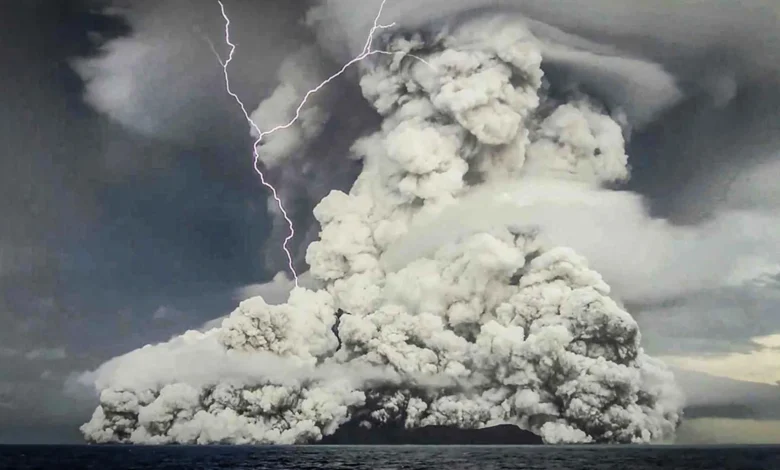
When the Hunga Tonga-Hunga Ha’apai submarine volcano erupted violently beneath the South Pacific in January 2022, it sent shockwaves, tsunamis, and an unprecedented volume of water vapor into the Earth’s stratosphere. The cataclysmic event immediately registered as one of the most powerful volcanic phenomena of the modern era, capturing global scientific attention due to its sheer scale and the atmospheric anomalies it generated. Now, nearly three years after the initial blast, an international team of researchers has uncovered a fascinating, entirely unforeseen consequence of the eruption: the massive volcanic plume acted as an accidental atmospheric purification system, actively destroying a significant portion of the methane pollution generated by the volcano itself.
The findings, recently published in the peer-reviewed journal Nature Communications, offer fresh insights into atmospheric chemistry. More importantly, they provide scientists with a natural blueprint that could eventually inform human strategies for mitigating near-term global warming. By observing how nature accelerates the breakdown of methane—a potent, short-lived greenhouse gas—researchers hope to better understand global climate cycles and potentially develop novel methods for atmospheric remediation.
Chronology of an Unprecedented Eruption and Atmospheric Discovery
The chain of events leading to this breakthrough began in late December 2021 and culminated on January 15, 2022, when the Hunga Tonga-Hunga Ha’apai volcano, located about 65 kilometers north of Tonga’s capital, Nukuʻalofa, suffered a colossal explosion. The eruption obliterated much of the uninhabited island and propelled an enormous plume of ash, sulfur dioxide, water vapor, and sea salt directly into the stratosphere, punching through the troposphere to record-breaking heights.
In the days and weeks following the eruption, scientific instruments worldwide turned their focus toward the Southern Hemisphere. Among these instruments was TROPOMI (TROPOsphomiic Monitoring Instrument), an advanced satellite payload aboard the European Space Agency’s Sentinel-5P satellite. TROPOMI routinely scans the globe to monitor atmospheric constituents related to air quality and climate forcing.
As researchers analyzed the satellite data, they detected an anomalous chemical signal within the stratospheric plume: exceptionally high concentrations of formaldehyde. In atmospheric chemistry, formaldehyde serves as a fleeting intermediary byproduct generated when methane molecules are broken down. Because formaldehyde breaks down within hours, its prolonged and elevated presence acts as a chemical fingerprint, signaling that an active destruction process is continuously occurring.
Dr. Maarten van Herpen of Acacia Impact Innovation BV, the lead author of the study, noted the surprise team members experienced upon reviewing the data. The research team was able to track the formaldehyde-laden cloud for ten consecutive days as it drifted across the Pacific Ocean all the way to South America. Because formaldehyde exists for only a brief window, this continuous trail demonstrated that the volcanic cloud was actively destroying methane for over a week. While volcanoes are known to vent methane during eruptions, this marked the first time scientists observed volcanic ash playing a direct role in mitigating that very pollution.
Deconstructing the Chemistry: Salt, Sunlight, and Stratospheric Reactions
To explain how volcanic ash could systematically destroy methane at such high altitudes, the research team looked to a newly discovered chemical mechanism first identified in a completely different context in 2023.
In that earlier study, scientists determined that Saharan dust blown across the Atlantic Ocean mixes with sea salt left behind by breaking ocean waves. This combination creates microscopic airborne particles known as iron salt aerosols. When sunlight strikes these aerosols, photochemical reactions trigger the release of highly reactive chlorine atoms. Chlorine is exceptionally aggressive in its chemical interactions, allowing it to attack and dismantle stable methane molecules in the troposphere.
However, the Hunga Tonga eruption adapted this chemical pathway to an entirely new environment: the stratosphere. Because the volcano was situated beneath the ocean, the explosion violently vaporized and thrust immense quantities of salty seawater, alongside pulverized volcanic rock and ash, directly into the stratosphere.
According to Professor Matthew Johnson from the Department of Chemistry at the University of Copenhagen and a co-author on both studies, the convergence of volcanic ash, sea salt, and intense stratospheric sunlight created ideal conditions for this halogen-driven chemistry. The sunlight catalyzed the mixture, releasing reactive chlorine atoms that subsequently reacted with methane molecules inside the plume. The massive spikes in formaldehyde detected by TROPOMI confirmed that this destruction cycle was operating on a massive scale.
Quantifying the Impact: Emissions Versus Removal
To understand the magnitude of this chemical reaction, the research team calculated both the volume of methane injected into the atmosphere by the eruption and the rate at which the plume subsequently removed it.
The calculations revealed that the Hunga Tonga eruption released approximately 300 gigagrams (Gg) of methane—an output roughly equivalent to the annual methane emissions produced by more than two million cattle. Simultaneously, however, the resulting volcanic plume dismantled roughly 900 megagrams (Mg) of methane per day, matching the daily emissions footprint of an additional two million cows.
While the absolute volume of methane destroyed by the plume does not single-handedly reverse global trends, the sheer efficiency of the natural process caught atmospheric scientists off guard. It demonstrated that mineral dust and sea salt acting in the stratosphere can serve as powerful sinks for greenhouse gases under specific, highly energetic conditions.
Broader Implications for the Global Methane Budget
The discovery carries profound implications for how scientists calculate the global methane budget, which acts as a comprehensive accounting ledger tracking all sources and sinks of atmospheric methane. Historically, climate models have accounted for methane inputs from wetlands, enteric fermentation in livestock, fossil fuel extraction, and geological seeps, juxtaposed against removal via hydroxyl (OH) radicals in the troposphere.
However, atmospheric mineral dust and volcanic emissions have not been fully or accurately integrated into these predictive models as active methane sinks. The findings from the Hunga Tonga study suggest that previous estimates regarding atmospheric lifetimes and chemical destruction pathways may require substantial revision.
"We now know that atmospheric dust—for example, from a volcanic eruption—impacts the methane budget, meaning the budget of how much methane is added to the atmosphere and how much is removed," Professor Johnson explained. "Because dust has not previously been taken into account, it is important that we correct the data on which these estimates are based."
The Urgency of Methane Mitigation
Methane is currently responsible for approximately one-third of anthropogenic global warming. Although its atmospheric concentration is vastly lower than that of carbon dioxide, methane’s heat-trapping efficiency is extraordinary. Over a 20-year timescale, methane is roughly 80 times more potent than carbon dioxide at warming the planet.
Crucially, methane possesses a much shorter atmospheric lifetime than carbon dioxide. While CO2 can linger in the atmosphere for centuries, driving long-term climate change, methane naturally degrades through chemical reactions within roughly a decade. This short lifespan makes methane an exceptionally attractive target for near-term climate intervention.
Climate scientists frequently describe aggressive methane reduction as an "emergency brake" on global warming. Rapidly lowering methane concentrations can yield noticeable reductions in global radiative forcing within a decade, potentially preventing humanity from crossing critical and irreversible climate tipping points. Nevertheless, researchers emphasize that methane mitigation cannot replace carbon dioxide reductions; long-term planetary stabilization ultimately demands a decisive phase-out of fossil fuels and heavy CO2 emissions.
Technological Challenges and Future Research Directions
The revelation that natural aerosols can catalyze rapid methane destruction has naturally sparked interest in whether human ingenuity can safely replicate or scale this phenomenon. Researchers and climate technology firms are increasingly investigating atmospheric methane removal strategies—methods designed to actively accelerate the breakdown of existing atmospheric methane rather than merely halting new emissions.
Hunga Tonga serves as a macroscopic, real-world proof of concept for halogen-mediated atmospheric chemistry. Yet, translating this natural process into a safe, controlled technological intervention presents immense scientific and regulatory hurdles. Chief among these challenges is verification. Because atmospheric methane is diffuse and spread over vast spatial scales, measuring small concentration changes attributable to an artificial intervention is exceptionally difficult.
Dr. Jos de Laat of the Royal Netherlands Meteorological Institute, a senior author of the study, pointed out that the research team’s methodology offers a path forward for solving verification challenges. By demonstrating that satellite instruments like TROPOMI can track specific intermediate markers like formaldehyde inside an aerosol-rich plume, scientists have established a viable framework for monitoring large-scale atmospheric chemistry from space.
Technical Hurdles in Satellite Remote Sensing
Utilizing TROPOMI to detect stratospheric formaldehyde inside a volcanic cloud was no simple task. The instrument was originally engineered to monitor air pollution within the lower troposphere under standard background conditions. Detecting trace gases inside a high-altitude volcanic plume pushed the satellite sensor well beyond its intended operational parameters.
Dr. Isabelle De Smedt of the Royal Belgian Institute for Space Aeronomy detailed the rigorous data processing required to validate the findings. The research team had to carefully adjust the satellite’s sensitivity metrics to account for the extreme altitude of the stratospheric signal. Furthermore, they had to filter out severe optical interference caused by massive concentrations of sulfur dioxide co-existing within the same plume. Only after these precise corrections were applied could the team confirm that the formaldehyde signals were genuine and directly correlated with methane destruction.
A Blueprint for the Future
As climate policymakers search for innovative tools to combat escalating temperatures, natural phenomena like the Hunga Tonga-Hunga Ha’apai eruption offer valuable lessons. While any intentional manipulation of stratospheric chemistry will require exhaustive study to evaluate unintended ecological or atmospheric consequences, the event has fundamentally altered our understanding of atmospheric self-cleansing mechanisms.
"It’s an obvious idea for industry to try to replicate this natural phenomenon—but only if it can be proven to be safe and effective," concluded Professor Johnson. "Our satellite method could offer a way to help figure out how humans might slow global warming."
The research was supported by Spark Climate Solutions and featured contributions from scientists representing institutions across the Netherlands, Belgium, Spain, Denmark, and beyond. As data from the Hunga Tonga eruption continues to be analyzed, it leaves behind a legacy that extends far beyond the physical devastation of the South Pacific event: a clearer, data-driven window into the complex chemical resilience of Earth’s atmosphere.