
Conquering the Inner Critic: Strategies for Overcoming Self-Doubt and Unleashing Your Potential
Self-doubt is a pervasive internal experience characterized by a lack of confidence in one’s own abilities, worth, or judgment. It manifests as persistent negative self-talk, a fear of failure, and an inability to recognize personal strengths. This internal monologue often whispers insidious suggestions that one is not good enough, intelligent enough, or capable enough to achieve desired outcomes or even to navigate daily life effectively. The roots of self-doubt are multifaceted, often stemming from early life experiences, societal pressures, past failures, or comparisons with others. It can paralyze action, hinder growth, and significantly impact mental well-being, leading to anxiety, depression, and a general sense of dissatisfaction. Recognizing self-doubt is the crucial first step; understanding its origins and developing proactive strategies is essential for dismantling its hold and fostering a more resilient and self-assured mindset.
Understanding the psychological underpinnings of self-doubt is critical to effectively address it. At its core, self-doubt is a cognitive distortion, a misinterpretation of reality that leads to a negative self-assessment. Cognitive behavioral therapy (CBT) offers significant insights into this phenomenon, positing that our thoughts, feelings, and behaviors are interconnected. Negative thought patterns, such as all-or-nothing thinking (e.g., "If I’m not perfect, I’m a failure"), overgeneralization (e.g., "I failed this one task, so I’ll always fail"), and mental filtering (focusing solely on the negatives and ignoring the positives), fuel self-doubt. These distortions create a self-perpetuating cycle: a perceived failure reinforces negative beliefs, leading to more avoidance and further reinforcing the belief of inadequacy. Neuroscientifically, chronic stress and anxiety, often byproducts of self-doubt, can alter brain structure and function, particularly in areas associated with self-regulation and emotional processing, making it harder to challenge these negative thought patterns. Furthermore, evolutionary psychology suggests that a degree of caution and self-assessment can be adaptive, preventing us from taking reckless risks. However, in modern society, this mechanism can become overactive, leading to excessive self-criticism that hinders progress rather than protecting us. Unpacking these underlying mechanisms provides a framework for targeted interventions.
Identifying the specific triggers of self-doubt is paramount for developing personalized coping mechanisms. These triggers can be internal or external. Internal triggers often involve confronting challenging tasks, experiencing setbacks, or engaging in self-comparison. When faced with a new project, a difficult exam, or a demanding social situation, individuals prone to self-doubt may immediately question their preparedness and ability to succeed. External triggers can include criticism from others, witnessing the perceived successes of peers, or experiencing rejection. The digital age, with its curated highlight reels on social media, presents a potent external trigger for self-doubt, fostering unrealistic comparisons and fueling feelings of inadequacy. Recognizing these triggers allows for proactive preparation and the development of in-the-moment coping strategies. For instance, if public speaking is a trigger, anticipating the situation, preparing thoroughly, and practicing mindfulness techniques beforehand can mitigate the onset of doubt. Similarly, if social media comparison is a trigger, setting boundaries around usage or consciously reframing the perceived realities presented online can be beneficial. A thorough self-inventory of situations, interactions, and internal thoughts that precede feelings of doubt is the first step towards effectively managing them.
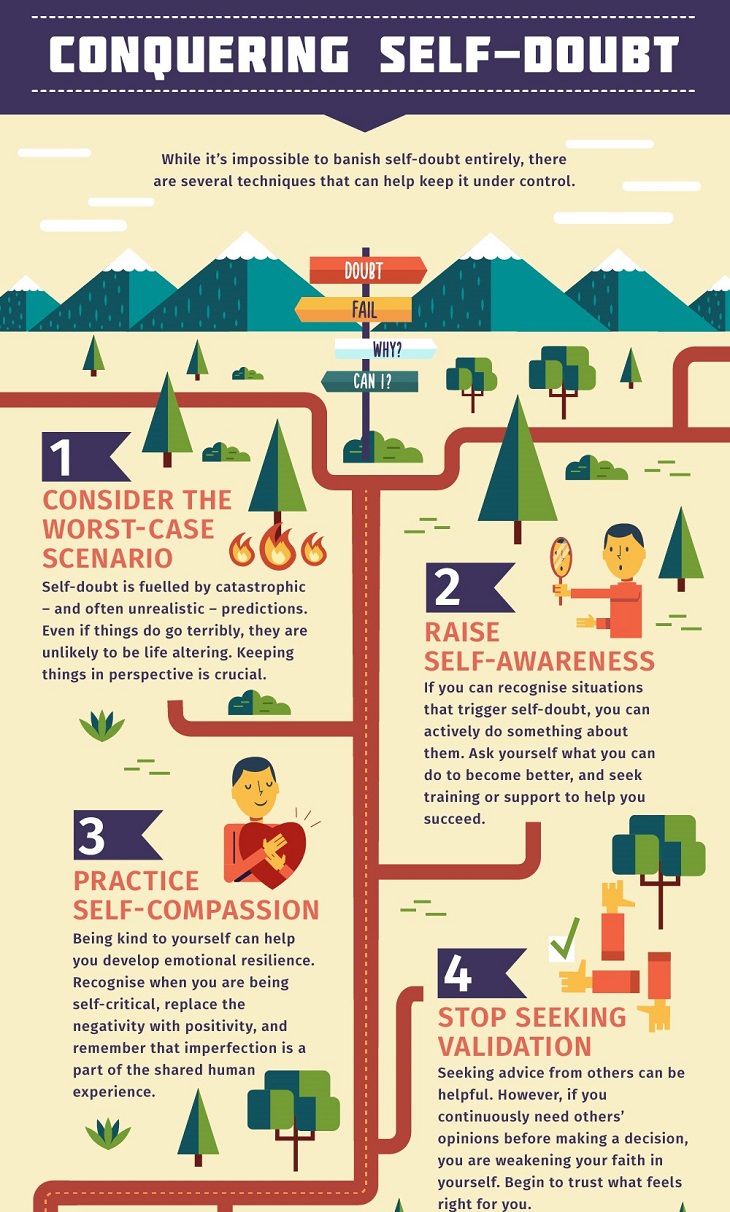
Challenging negative self-talk is a cornerstone of overcoming self-doubt. This involves actively identifying and reframing the persistent, critical inner voice. Instead of accepting these negative statements as truths, individuals can learn to question their validity. For example, if the thought "I’m not smart enough for this" arises, one can ask: "What evidence do I have that this is true? What evidence contradicts it? Is there a more balanced way to view this?" This process involves cognitive restructuring, where the aim is to replace irrational or unhelpful thoughts with more realistic, balanced, and constructive ones. It’s about developing a more compassionate and objective inner dialogue. Techniques like thought stopping, where one mentally halts a negative thought and replaces it with a positive affirmation, can be employed. Alternatively, one can practice “thought observation,” acknowledging the negative thought without judgment and then consciously shifting focus to a more productive or neutral one. The goal is not to eliminate negative thoughts entirely, as this is unrealistic, but to reduce their frequency, intensity, and believability. This requires consistent practice, akin to building a muscle.
Building self-compassion is intrinsically linked to dismantling self-doubt. Self-compassion involves treating oneself with the same kindness, understanding, and acceptance that one would offer a dear friend who is struggling. It acknowledges that suffering, failure, and inadequacy are part of the human experience, rather than personal flaws. Three core components of self-compassion are self-kindness, common humanity, and mindfulness. Self-kindness means being gentle with oneself during times of difficulty, rather than engaging in harsh self-criticism. Common humanity recognizes that suffering is shared and that one is not alone in their struggles. Mindfulness involves being present with one’s experiences, both positive and negative, without judgment. Practicing self-compassion can involve active self-soothing techniques, such as placing a hand over one’s heart and offering oneself comforting words, or writing a compassionate letter to oneself. By cultivating a more nurturing internal environment, individuals can create a buffer against the corrosive effects of self-doubt.
Focusing on strengths and past achievements provides tangible evidence against self-doubt. Many individuals with self-doubt tend to magnify their weaknesses and overlook their accomplishments. Regularly engaging in an inventory of personal strengths, skills, and successful experiences can counter this tendency. This can involve creating a "success journal" where one records daily achievements, no matter how small. It might also include listing skills acquired, challenges overcome, and positive feedback received. When self-doubt arises, revisiting this list can serve as a powerful reminder of one’s capabilities. Furthermore, actively seeking opportunities to utilize and develop these strengths reinforces a positive self-image. Celebrating these successes, even privately, validates their significance and contributes to a more robust sense of self-efficacy, the belief in one’s ability to succeed in specific situations or accomplish a task. This evidence-based approach directly combats the often irrational nature of self-doubt.
Setting realistic goals and breaking down large tasks into smaller, manageable steps can significantly reduce the overwhelm that fuels self-doubt. Ambitious goals, while aspirational, can become daunting if approached as monolithic challenges. The fear of not being able to achieve such large objectives can trigger intense self-doubt. By implementing the SMART goal framework (Specific, Measurable, Achievable, Relevant, Time-bound), individuals can create a roadmap for progress that feels less intimidating. Deconstructing a project into its constituent parts allows for incremental successes. Each completed step provides a sense of accomplishment and builds momentum, reinforcing the belief that progress is possible. This approach fosters a sense of control and agency, directly counteracting the helplessness often associated with self-doubt. For example, instead of aiming to "write a book," a more manageable approach would be to "outline the book’s chapters by Friday" or "write 500 words today."
Embracing failure as a learning opportunity is a crucial mindset shift for overcoming self-doubt. The fear of failure is a primary driver of self-doubt, leading to avoidance and inaction. However, failure is an inevitable and often essential part of growth and learning. By reframing failure not as a reflection of personal inadequacy but as valuable feedback, individuals can lessen its sting. Analyzing what went wrong, identifying lessons learned, and applying those insights to future endeavors transforms setbacks into stepping stones. This perspective encourages experimentation and risk-taking, knowing that even unsuccessful attempts provide valuable data. This resilience-building approach allows individuals to persevere in the face of adversity, recognizing that setbacks are temporary and do not define their ultimate capabilities. The focus shifts from the outcome to the process of learning and adaptation.
Seeking support from others is a powerful antidote to the isolating nature of self-doubt. Connecting with trusted friends, family members, mentors, or a therapist can provide external validation, different perspectives, and practical encouragement. Sharing one’s struggles with others can illuminate the irrationality of self-doubt and offer a sense of shared experience. A mentor can offer guidance based on their own journey, while a therapist can provide professional tools and strategies for managing negative thought patterns and building self-esteem. Actively engaging in supportive relationships creates an external network of confidence that can bolster internal self-belief. This external affirmation can be particularly important when internal self-validation is faltering. Importantly, choosing individuals who are supportive and non-judgmental is essential for this process.
Mindfulness and meditation practices can cultivate present-moment awareness and detach individuals from their self-critical thoughts. By observing thoughts without judgment, individuals learn to recognize that their thoughts are not facts but transient mental events. Regular meditation can train the brain to be less reactive to negative self-talk, creating a greater sense of calm and control. This practice helps to foster a detached observer perspective, allowing one to witness self-doubt arise without being consumed by it. It encourages a more balanced and less emotionally charged response to internal criticism. Incorporating short, guided meditations into daily routines can be highly effective in developing this skill over time, reducing the impact of intrusive and self-defeating thoughts.
Developing resilience is a long-term strategy that involves cultivating the capacity to bounce back from adversity, a direct countermeasure to self-doubt. This involves a combination of the strategies already discussed: self-compassion, challenging negative thoughts, learning from mistakes, and building supportive relationships. Resilience is not about avoiding difficulties, but about navigating them effectively. It’s about recognizing that life will present challenges and developing the internal resources and external support systems to meet them. This fosters a proactive approach to life, where setbacks are viewed as opportunities for growth rather than reasons to give up. The development of resilience leads to a more robust sense of self-efficacy and a greater capacity to persevere in the face of obstacles.
Gradually exposing oneself to situations that trigger self-doubt in a controlled and incremental manner can build confidence and reduce anxiety. This is akin to exposure therapy. For example, if public speaking is a source of doubt, start by practicing in front of a mirror, then a small group of friends, then a larger audience. Each successful experience, even a small one, builds a stronger belief in one’s ability to handle similar situations in the future. This gradual desensitization process weakens the association between the triggering situation and the feeling of self-doubt. It allows individuals to gather positive evidence of their competence, directly refuting the negative predictions of self-doubt. This deliberate practice in overcoming challenges is a powerful way to cultivate self-assurance.
Finally, celebrating progress, no matter how small, reinforces positive behaviors and builds momentum. Acknowledging and rewarding oneself for overcoming self-doubt and implementing these strategies is crucial. This could be a simple act of self-appreciation, a small indulgence, or sharing the success with a supportive person. This positive reinforcement strengthens the neural pathways associated with self-confidence and encourages continued effort. The journey of overcoming self-doubt is ongoing, and consistent positive reinforcement plays a vital role in maintaining progress and fostering a lasting sense of self-belief.

