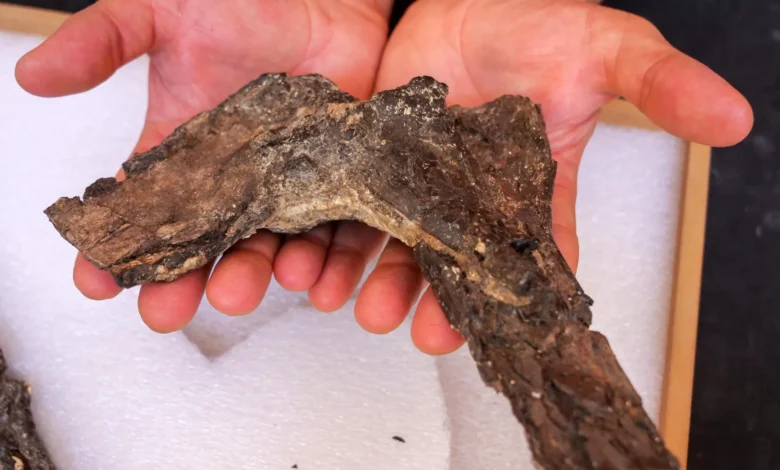
In a monumental achievement for paleontology, an international team of scientists has uncovered remarkably preserved traces of dinosaur blood trapped securely inside 115-million-year-old bones. This unprecedented discovery shatters previous scientific timelines regarding the degradation of organic molecules, proving that delicate biological materials can survive across geological epochs under exceptionally rare conditions. The breakthrough centers on the fossilized remains of Aratasaurus museunacionali, a predatory theropod dinosaur unearthed in the arid landscapes of northeastern Brazil. Published in the prestigious Proceedings of the National Academy of Sciences, the research not only delivers the first definitive chemical proof of hemoglobin-derived molecules in dinosaur red blood cells but also introduces a paradigm shift that could alter how researchers investigate prehistoric physiology and even search for biosignatures in extraterrestrial environments.
The collaborative research initiative was spearheaded by John Curtin Distinguished Professor Kliti Grice, the founding director of Curtin University’s WA-Organic and Isotope Geochemistry Centre and an Australian Research Council Laureate Fellow. Working alongside a multidisciplinary team spanning institutions such as the Japan Agency for Marine-Earth Science and Technology, the Brazilian National Museum, the Regional University of Cariri, and Johns Hopkins University, Professor Grice and her colleagues deployed cutting-edge analytical techniques to peer deep inside the microscopic architecture of the ancient bones. Their findings confirm that chemical remnants of life can endure far longer than conventional biochemical models ever deemed possible, opening an entirely new frontier in molecular paleontology.
Unraveling the Microscopic Architecture of a Prehistoric Predator
To understand the magnitude of the discovery, one must look deep within the microscopic anatomy of the dinosaur’s limb bones. Utilizing advanced imaging and spectrometry, the researchers examined the vascular canals—the microscopic tunnels that once housed blood vessels to nourish the living bone tissue. Within these intricate pathways, scientists identified a dense distribution of mineralized red blood cells.
While previous paleontological studies had occasionally reported isolated structures resembling ancient blood cells in exceptionally preserved fossils, those earlier claims were often met with healthy skepticism from the broader scientific community. Critics frequently argued that such structures were merely artifacts of diagenesis, such as microbial biofilms or mineral precipitates that coincidentally mimicked the size and shape of biological cells.
This new study, however, transcends morphological identification by providing rigorous, undeniable chemical validation. Through sophisticated molecular analysis, the team detected intact heme molecules—the oxygen-transporting iron-binding components intrinsic to hemoglobin—safely locked inside the fossilized red blood cells. Furthermore, the researchers isolated specific amino acids associated with collagen, the primary structural protein that forms the scaffolding of bones and connective tissues. By bridging the gap between structural morphology and molecular chemistry, the research team has furnished the scientific community with incontrovertible proof that genuine organic residues from the Cretaceous period can be preserved down to the molecular level.
The Geological Time Capsule: How Ancient Biomolecules Survived
The survival of delicate biological molecules for 115 million years presents a fascinating geochemical mystery. Under normal conditions, proteins, lipids, and DNA begin to degrade rapidly through hydrolysis and oxidation almost immediately after an organism’s death, breaking down completely within thousands—or at most a few million—years. The preservation of these fragile structures over more than a century of millions of years requires an extraordinary convergence of environmental and chemical factors.
The key to this subterranean preservation lies in a specific mineral: hausmannite. According to the research team, hausmannite played a critical stabilizing role, acting as a natural chemical shield that locked the red blood cells and their molecular contents in place, effectively insulating them from environmental degradation. This mineral matrix formed a protective microenvironment that arrested the decay of organic compounds throughout the tumultuous shifts of geological time.
Furthermore, the taphonomic conditions—the circumstances surrounding the burial and fossilization of the dinosaur—were ideal. Paleontologists suspect that shortly after death, the Aratasaurus specimen was rapidly entombed by fine-grained sediments in an oxygen-depleted, or anoxic, depositional environment. This rapid burial shielded the carcass from scavengers and surface weathering, while low oxygen levels drastically curtailed the activity of aerobic microbes that typically consume organic matter. Combined with abundant localized microbial activity that facilitated specific mineral precipitation, these unique environmental parameters created a pristine natural time capsule, freezing a snapshot of Cretaceous biology in stone.
Perspectives and Reactions from the Scientific Community
The academic community has received the findings with a mixture of astonishment and profound appreciation for the methodological rigor applied by the Curtin University-led team. The integration of advanced geochemistry with classical paleontology has set a new benchmark for fossil analysis.
"To detect intact heme-derived molecules in 115-million-year-old red blood cells is astonishing: this really is a landmark discovery," stated Professor Kliti Grice, reflecting on the weight of the analytical results. "It not only extends the known fossil record of blood, but also offers a direct molecular window into the physiology of long-extinct animals so we may better understand them and the world they lived in."
Professor Martin Van Kranendonk, head of Curtin University’s School of Earth and Planetary Sciences, echoed these sentiments, emphasizing the broader philosophical and scientific implications of the work. "This study exemplifies how coordinated efforts across institutions, continents and scientific disciplines can unlock extraordinary insights into ancient life," Van Kranendonk noted. He added that the results fundamentally alter our understanding of how molecular structures withstand extreme geological timescales, forcing a re-evaluation of long-held dogmas in organic geochemistry.
Challenging Dogma and Expanding the Horizons of Molecular Paleontology
For generations, biological textbooks and mainstream paleontology taught that organic molecules possessed a strict expiration date. Standard biochemical decay models dictated that proteins and cellular components could not possibly persist past a few million years, rendering the study of dinosaur soft tissue a theoretical impossibility. This discovery directly challenges that foundational assumption, proving that under optimal geochemical circumstances, nature can defy expected degradation limits.
The confirmation of preserved heme and collagen molecules opens up sweeping new avenues of research. Paleontologists are no longer restricted to studying the gross morphology of bones—such as size, shape, and muscle attachment scars—to infer how extinct animals lived. Instead, molecular paleontology allows scientists to probe deeper into the evolutionary history of metabolism, respiration, and physiological adaptation.
By analyzing the chemical signatures preserved within bones, future researchers may be able to reconstruct the metabolic rates, thermoregulation strategies, and cardiovascular capacities of dinosaurs and other prehistoric creatures. This granular data provides a much more dynamic, living portrait of creatures that have been extinct for tens of millions of years, transforming rigid stone fossils into active archives of biological history.
Broader Implications for Astrobiology and the Search for Extraterrestrial Life
Perhaps the most far-reaching implication of this discovery extends beyond terrestrial paleontology and directly into the realm of astrobiology. The realization that delicate biological molecules can survive for well over 100 million years provides critical new parameters for scientists searching for traces of ancient life in harsh environments, both on Earth and across the solar system.
Astrobiologists studying Mars, icy moons like Europa and Enceladus, and other planetary bodies frequently grapple with the problem of biosignature degradation. If organic molecules exposed to ionizing radiation and planetary weathering over geological timescales can retain their structural integrity under specific mineralogical shelters, it fundamentally shifts how space agencies design detection protocols for extraterrestrial missions.
If the right mineral matrices—similar to the hausmannite found in the Brazilian fossil—can protect molecular signatures across terrestrial epochs, similar geological traps on other planets might preserve ancient microbial life forms far more effectively than previously anticipated. Consequently, researchers hunting for past life on Mars or within meteorite samples may need to adjust their analytical targets, looking closely at specific mineral-bound microenvironments where delicate biomarkers could be safely sequestered.
Conclusion and Future Outlook
The publication of "Heme signatures in mineralized red blood cells within vascular canals of a 115-million-year-old dinosaur bone" in the Proceedings of the National Academy of Sciences marks a watershed moment in modern science. By successfully extracting and verifying molecular blood components from the remains of Aratasaurus museunacionali, the international research team has bridged the gap between deep time and molecular biology.
As funding bodies, including the Australian Research Council through its Laureate Fellowship program, continue to support cross-disciplinary investigations, the boundaries of what we can learn from the fossil record will continue to expand. What began as an excavation of ancient bones in northeastern Brazil has ultimately evolved into a transformative study with ramifications for evolutionary biology, organic chemistry, and the cosmic search for life beyond our home planet. The stone may be ancient, but the molecular secrets it guards are finally beginning to speak.