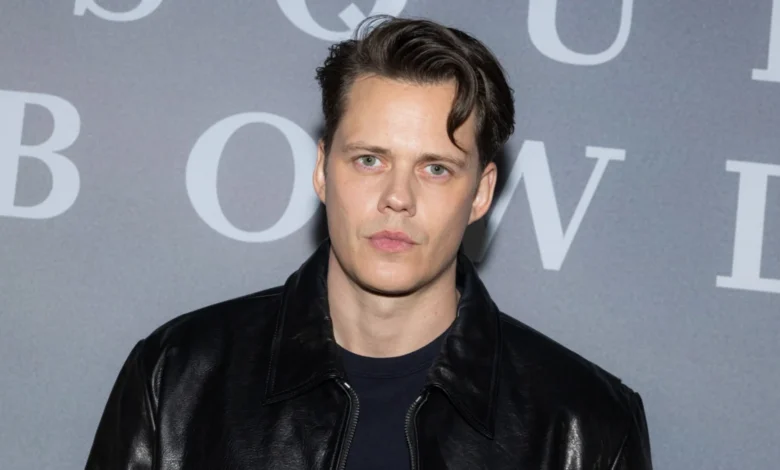
The landscape of modern Hollywood is often defined by the archetypes actors inhabit, and few have carved out a niche as distinct—or as dark—as Swedish actor Bill Skarsgard. From the nightmarish, sewer-dwelling entity Pennywise in the record-breaking It franchise to the brooding, vengeful spirit of Eric Draven in The Crow and the sophisticated menace of the Marquis in John Wick: Chapter 4, Skarsgard has become a go-to performer for complex antagonists. However, as the industry looks toward the next iteration of the iconic 007 franchise, the actor has signaled a pivotal shift in his career trajectory, expressing a desire to move away from the villainous roles that have defined his recent filmography.
During a candid appearance on the popular Happy Sad Confused podcast hosted by Josh Horowitz, Skarsgard addressed his professional evolution with surprising honesty. While his resume is decorated with high-profile dark characters, including the titular role in the upcoming Nosferatu, the 36-year-old actor confessed that he feels mentally and creatively exhausted by the demands of playing antagonists.
A Creative Crossroads: The Toll of Dark Characters
The phenomenon of "typecasting" is a recurring challenge for actors who find early success in horror or thriller genres. For Skarsgard, the challenge has been compounded by the physical and emotional intensity required to embody characters like the Marquis or the malevolent Count Orlok.
"For a villain, it would have to be something that felt original to me, that was something that I hadn’t done before," Skarsgard explained to Horowitz. "I feel, kind of, spent with those things. But there’s villains that could be really fun in different ways and if it’s the right kind."
His sentiment highlights a growing awareness in the acting community regarding the psychological toll of "method-adjacent" preparation. To play a villain effectively, an actor must often tap into darker recesses of human nature for months at a time. After years of sustained exposure to these roles, Skarsgard’s declaration that he is "spent" suggests he is entering a new phase of his career where he intends to prioritize range over recognition.
The James Bond Ambiguity
The conversation inevitably pivoted to one of the most coveted roles in cinema: James Bond. For years, rumors have swirled regarding potential candidates for the role, with fans and critics alike frequently casting Skarsgard as a potential villain or even a contender for the lead.
When asked about the prospect of joining the Bond universe, Skarsgard offered a mix of humor and blunt reality. He noted that despite the fan discourse, he had never been approached for the franchise. "Yeah! Well, because they didn’t call me about James Bond. I don’t know what that was about," he said with a laugh. "Maybe they were like, ‘We can’t do a Swede for this guy.’ I wasn’t even thrown into the mix."
His comments clarify a long-standing misconception. While he expressed an interest in the franchise, he clarified that he would not be interested in the grueling, decade-long commitment required to play the lead character. Instead, he expressed admiration for the "one-off" villain roles historically occupied by actors like Mads Mikkelsen (Le Chiffre in Casino Royale) and Javier Bardem (Silva in Skyfall). These performances allow for a singular, high-impact appearance without the burden of anchoring a 15-year franchise.
Contextualizing the 007 Casting Search
Skarsgard’s admission comes at a critical juncture for Eon Productions and the James Bond franchise. Since Daniel Craig’s departure following No Time to Die in 2021, the search for the next 007 has been subject to immense public scrutiny. Recent reports from The Hollywood Reporter have indicated that the studio is currently in the late stages of evaluating a shortlist of top-tier talent.
The vetting process for a new Bond is notoriously rigorous, involving extensive screen tests and chemistry readings to ensure the actor can embody the blend of suave charm and lethal efficiency that the character demands. According to industry insiders, the current shortlist has included names such as Callum Turner, Jack Lowden, and Josh O’Connor. The recent revelation that Robert Pattinson had also engaged in screen tests has further intensified speculation, underscoring the studio’s desire to find a performer who can balance critical acclaim with massive commercial appeal.
The timeline for the next Bond film remains somewhat fluid, particularly with director Denis Villeneuve reportedly attached to shape the new era. The studio is under no immediate pressure to rush, as the franchise remains a crown jewel of British cinema that demands careful curation.
Professional Trajectory and Future Projects
While Skarsgard may be distancing himself from the villain archetype, his current work remains as robust as ever. He is currently starring in Peter Berg’s war drama, The Mosquito Bowl, a film that showcases a different side of his acting abilities. The film, which has received attention for its historical gravity and intense performances, is currently in theaters and scheduled for a wide release on Netflix on November 25.
This transition into prestige drama and war-themed narratives may be the exact direction Skarsgard needs to cleanse his palette. By pivoting toward roles that require nuanced emotional depth rather than the stylized cruelty of a horror villain, he is positioning himself for a longevity that relies on versatility.
The Broader Implications for Casting
The industry-wide trend of casting "prestige" actors as villains has been a hallmark of the 2010s and early 2020s. Studios often look for performers with a high degree of screen presence to ground their antagonists, ensuring that the conflict feels visceral. However, as stars like Skarsgard vocalize their hesitation, casting directors may need to reconsider how they approach the "big bad" role.
The move away from villainous roles is not merely a personal preference; it is a tactical career maneuver. In an era where the Marvel and DC universes, as well as high-concept horror franchises, frequently cycle through antagonists, actors are becoming more protective of their brand. The risk of being defined by a single type of role is significant, and for a performer of Skarsgard’s caliber, the drive to avoid artistic stagnation is paramount.
Analysis: The Future of the Villain Archetype
The "villain" in modern cinema has evolved from the mustache-twirling caricature of the mid-20th century to the psychologically complex, often sympathetic, antagonist of the modern era. Actors like Skarsgard have been instrumental in this shift, bringing a level of humanity to their roles that makes them difficult to ignore.
However, there is a clear ceiling to how many times an actor can reinvent the "monster." If the industry continues to rely on the same pool of talent for these roles, it risks audience fatigue and, more importantly, a decline in the quality of performances as actors lose their enthusiasm for the material.
As Skarsgard looks toward the future, his legacy as one of the great character actors of his generation is already secured. Whether he finds himself in the Bond universe as a one-off antagonist or transitions entirely into the realm of protagonist-led dramas, his career remains a barometer for the changing priorities of modern leading men. His candidness on the Happy Sad Confused podcast serves as a reminder that even the most formidable on-screen threats are, at their core, artists seeking the next challenge—not the same one they’ve already conquered.
For now, audiences can look forward to seeing him in The Mosquito Bowl, a project that offers a departure from the supernatural and the grotesque. As the cinematic landscape shifts, it is likely that Skarsgard’s career will continue to evolve, moving further away from the shadows of Pennywise and toward a future that is, hopefully, a little brighter.