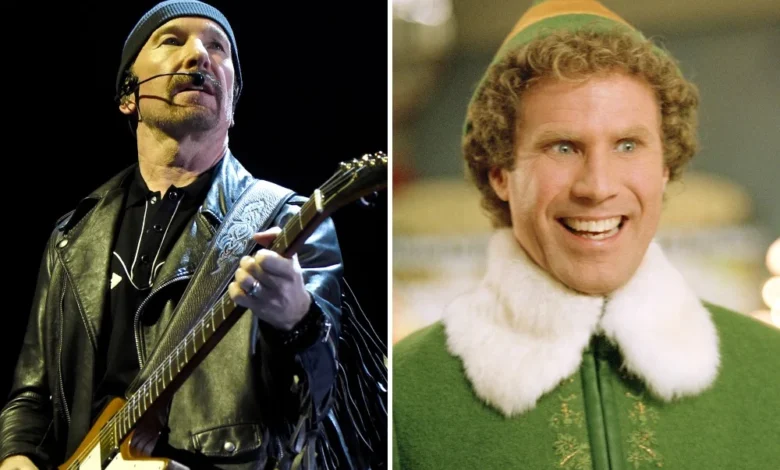
The holiday season has long been a lucrative period for Hollywood studios, yet few modern Christmas movies have achieved the enduring cultural footprint of the 2003 comedy Elf. Directed by Jon Favreau and starring Will Ferrell as the lovable, human-raised North Pole dweller Buddy, the film remains a staple of annual holiday viewing. However, newly surfaced revelations from actor and author Andy Richter have shed light on a bizarre and largely unknown chapter in Hollywood history: the existence of multiple unproduced sequel scripts, including one written by none other than The Edge, the iconic guitarist for the rock band U2.
According to Richter, who appeared in a minor role in the original film and co-authored the newly released behind-the-scenes book Elf Unwrapped: Behind the Scenes of a Modern Christmas Classic, the pursuit of a follow-up film was more active than previously known. Despite the rich conceptual efforts of high-profile musicians and seasoned comedy writers, the holiday classic has successfully avoided the fate of a sequel for more than two decades—a decision that industry insiders and fans increasingly view as a blessing in disguise.
The Surreal Discovery of The Edge’s Script
The revelation regarding the U2 guitarist’s surprising foray into screenwriting came to light during a recent appearance by Richter on the podcast Obsessed: The Podcast. Richter recounted how Shauna Robertson, a prominent producer on the original Elf, received an unexpected and surreal pitch inquiry regarding David Howell Evans, universally known as The Edge.
As Richter detailed to the podcast listeners, an intermediary reached out to Robertson with a peculiar proposition: the U2 musician had independently penned a complete screenplay for Elf 2 and was eager to discuss putting it into production. The notion of a stadium-filling rock star drafting a family comedy sequel struck many as deeply eccentric, yet the script reportedly existed in full form.
"Somebody reached out to her and said, ‘The Edge from U2 has written a sequel to Elf, and he wants to talk to you about it,’" Richter shared during the podcast. "It’s the weirdest story, but apparently it was fully written. Somewhere in the world there is an Edge-penned Elf 2 out there… I would love for that to make the light of day."
Despite the novelty of the pitch, the project never advanced past initial pleasantries. Robertson agreed to a preliminary meeting out of professional courtesy, but the momentum quickly fizzled. The script was shelved, leaving the guitarist’s vision of Buddy the Elf locked away in an unproduced drawer of Hollywood cinematic lore.
A History of Alternative Sequels and Uncredited Writers
The Edge’s script was not the only attempt to drag Buddy back to the screen. Richter also disclosed that Scot Armstrong, a veteran comedy writer known for his work on Old School and The Hangover Part II, drafted a completely separate sequel script.
Armstrong’s version of Elf 2 leaned into high-concept comedic peril, centering on a plot involving "the evil South Pole elves kidnapping Santa or something like that," according to Richter. Notably, Richter also revealed that Armstrong had made uncredited contributions to the original 2003 film, having assisted with the writing process during production even though guild regulations and procedural hurdles prevented him from receiving formal credit on screen.
These divergent creative stabs at a sequel underscore the commercial pressures Hollywood traditionally faces when a modest-budget comedy overperforms at the box office. Yet, unlike many 2000s comedies that were swiftly rushed into franchise status, Elf resisted the pull of expansion, remaining a solitary cinematic entity.
The Cultural Legacy and Box Office Success of the 2003 Original
To understand why a sequel was so aggressively contemplated—and ultimately abandoned—it is necessary to examine the monumental trajectory of the original film. Released by New Line Cinema on November 7, 2003, Elf was a certified commercial success from the outset. Produced on an estimated budget of $33 million, the film grossed roughly $223 million worldwide during its theatrical run, a robust tally for a holiday comedy at the time.
Beyond its initial box office figures, the film’s financial and cultural longevity has compounded over the decades. Driven by home video sales, digital rentals, and heavy cable television rotation every November and December, Elf cemented itself alongside classics like It’s a Wonderful Life and A Christmas Story as essential holiday viewing.
The film’s success relied heavily on a precise alchemy of talent. Directed by Jon Favreau—years before he launched the Marvel Cinematic Universe with Iron Man—the movie balanced whimsical physical comedy with genuine emotional sincerity. Will Ferrell’s committed performance as Buddy, paired with a supporting cast that included James Caan as his cynical biological father Walter Hobbs, Zooey Deschanel as love interest Jovie, and Mary Steenburgen as stepmother Emily, created a world that felt both magical and grounded.
Why Fans and Creators Oppose a Franchise Expansion
As the cultural appreciation for the movie deepens, public sentiment regarding a potential sequel has hardened into staunch opposition. Andy Richter himself is among the most vocal advocates for leaving the film untouched, arguing that the risks of damaging a pristine reputation far outweigh any potential financial upside for a studio.
"I’m on the side of ‘Let it stand,’" Richter asserted. "Just let Elf be Elf. You don’t have to use every part of the animal."
He elaborated on the psychological barrier facing legacy sequels, noting that modern audiences are hyper-aware of how retrospective follow-ups can retroactively taint the affection held for originals. "Now that time has passed, the movie has become so special that I think that people, rightfully so, are loath to mess with it because we all can think of movies that have been tarnished by their sequels. And this is so special and so perfect and so beloved… Why risk it?"
Will Ferrell’s Well-Known Resistance to a Sequel
Richter’s protective stance mirrors that of the film’s star, Will Ferrell. Over the years, Ferrell has been famously transparent about turning down astronomical paydays to star in an Elf sequel. In various retrospective interviews, the comedian has confirmed that he was offered tens of millions of dollars to reprise his role as Buddy, but he consistently declined because the proposed plotlines merely recycled the beats of the original movie.
Ferrell’s hesitation highlights a rare instance of artistic integrity prevailing over corporate incentives in mainstream studio comedies. Rather than subjecting audiences to a diluted version of a beloved character navigating identical fish-out-of-water scenarios in New York City, the creative team chose to let the narrative rest.
The Broader Implications for Hollywood IP Management
The revelation that U2’s guitarist and major studio comedy writers attempted to draft sequels highlights the relentless machine of intellectual property expansion in the entertainment industry. In an era where legacy sequels, reboots, and cinematic universes dominate box office receipts, the containment of Elf stands as an anomaly.
Industry analysts often point to Elf as a textbook case of successful single-installment storytelling. While contemporary studios routinely greenlight sequels for any film crossing the $100 million threshold, the restraint shown by New Line Cinema—aided by the disinterest of its principal star—has preserved the film’s singular status.
As fans continue to celebrate the movie’s milestones, including the release of Richter’s comprehensive behind-the-scenes book Elf Unwrapped, the mystery of The Edge’s unproduced script serves as a fascinating footnote. It reminds pop culture enthusiasts of the alternate timelines that quietly drift through Hollywood executive suites—timelines where Santa Claus might have been rescued from evil South Pole elves under the thematic scoring of a U2 guitar riff.
Ultimately, however, the decision to leave the North Pole undisturbed has allowed the original 2003 classic to retain its untarnished magic, ensuring that Buddy the Elf’s infectious holiday spirit remains as pure today as it was upon his first arrival in New York City.