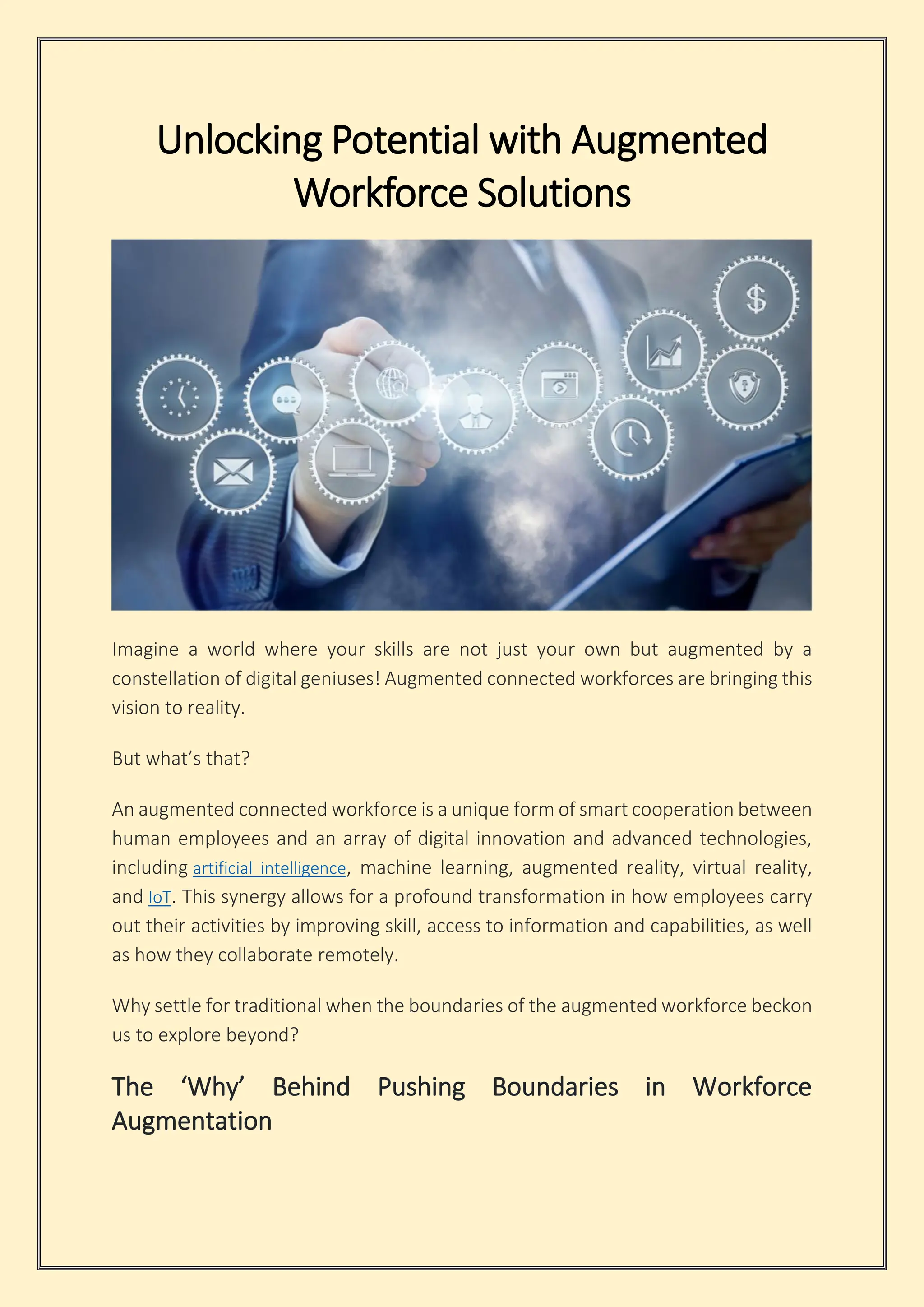

The Augmented Workforce: Maximizing Human Potential with AI and Automation
The modern business landscape is characterized by an insatiable demand for efficiency, innovation, and adaptability. Traditional hierarchical structures and purely human-driven operations are increasingly proving insufficient to meet these evolving challenges. The solution lies not in replacing human talent, but in augmenting it. An augmented workforce strategically integrates artificial intelligence (AI) and automation technologies to enhance human capabilities, unlock new levels of productivity, and foster a more dynamic and resilient organization. This approach moves beyond the simplistic dichotomy of "humans vs. machines" to a synergistic partnership where technology amplifies human intelligence and creativity. Understanding and effectively implementing an augmented workforce strategy is no longer a competitive advantage; it is rapidly becoming a prerequisite for sustained success. This article will delve into the multifaceted benefits of an augmented workforce, exploring how it empowers employees, optimizes operations, drives innovation, and ultimately reshapes the future of work for the better.
One of the most immediate and tangible benefits of an augmented workforce is the dramatic increase in operational efficiency. AI-powered tools and automation can handle repetitive, time-consuming, and error-prone tasks with speed and accuracy far exceeding human capabilities. This frees up human employees from mundane activities, allowing them to focus on higher-value work that requires critical thinking, problem-solving, creativity, and emotional intelligence. For instance, in customer service, AI-powered chatbots can handle routine inquiries, FAQs, and initial triage, escalating complex issues to human agents who can then dedicate their expertise to providing personalized and empathetic support. In manufacturing, robotic process automation (RPA) can automate data entry, report generation, and system updates, reducing manual effort and minimizing the risk of human error. This reallocation of human capital towards strategic initiatives directly translates to faster turnaround times, reduced operational costs, and improved throughput. Furthermore, AI can analyze vast datasets to identify bottlenecks and inefficiencies within workflows, providing actionable insights for continuous improvement. Predictive maintenance, powered by AI analyzing sensor data from machinery, can anticipate potential failures, allowing for proactive repairs and preventing costly downtime. This not only saves money but also ensures consistent operational flow, a critical factor in maintaining customer satisfaction and market competitiveness. The synergy here is profound: machines handle the predictable and the arduous, while humans are empowered to tackle the complex and the novel, creating a more robust and efficient operational framework.
Beyond mere efficiency, an augmented workforce significantly enhances employee experience and engagement. When employees are relieved of tedious and unfulfilling tasks, they gain the opportunity to engage in more intellectually stimulating and personally rewarding work. This elevation of their roles can lead to increased job satisfaction, reduced burnout, and a stronger sense of purpose. AI can act as a personalized assistant, providing employees with instant access to information, relevant data, and intelligent suggestions. For example, a sales representative can be augmented by an AI tool that analyzes customer history and suggests personalized product recommendations or optimal talking points during a sales call. Similarly, in research and development, AI can sift through vast scientific literature to identify relevant studies and potential breakthroughs, accelerating the innovation process. This augmentation empowers employees to be more effective and efficient in their roles, fostering a sense of mastery and contributing to a positive work environment. Moreover, AI-powered training and development platforms can offer personalized learning paths, adapting to individual skill gaps and career aspirations. This continuous upskilling not only benefits the employee by enhancing their marketability but also ensures the organization has a workforce equipped with the latest skills and knowledge. The human element is not diminished; it is elevated, allowing individuals to leverage their unique strengths in a more impactful way. When employees feel valued, empowered, and continuously learning, their engagement levels naturally rise, leading to higher retention rates and a more committed workforce.
The ability to drive innovation is profoundly amplified within an augmented workforce. AI’s capacity for pattern recognition, data analysis, and predictive modeling can uncover insights and opportunities that might remain hidden to human observation alone. This allows businesses to anticipate market trends, identify unmet customer needs, and develop novel products and services. For example, AI algorithms can analyze social media sentiment, customer reviews, and market research data to pinpoint emerging consumer preferences, guiding product development towards areas of high potential demand. In scientific research, AI can accelerate the discovery of new materials, drugs, and scientific principles by simulating complex experiments and analyzing vast datasets of chemical compounds or biological information. The iterative process of innovation is also sped up, as AI can quickly generate prototypes or test hypotheses, allowing for faster feedback loops and more agile development cycles. Human creativity is not replaced; it is catalyzed. AI can generate a multitude of ideas or potential solutions based on defined parameters, which human experts can then refine, select, and develop further. This symbiotic relationship between human ingenuity and AI-driven analytical power fosters a more fertile ground for groundbreaking ideas and faster realization of innovative solutions. Businesses that embrace this augmented approach are better positioned to stay ahead of the competition, adapt to disruptive technologies, and seize new market opportunities.
Data-driven decision-making is another critical benefit of the augmented workforce. AI excels at processing and analyzing immense volumes of data, identifying correlations, and generating actionable insights that inform strategic choices. This moves organizations away from intuition-based decision-making towards evidence-based strategies. For instance, AI can analyze sales data to predict demand for specific products, optimize inventory levels, and personalize marketing campaigns. In finance, AI can detect fraudulent transactions with unparalleled accuracy, assess credit risk, and optimize investment portfolios. The ability to access and interpret real-time data allows for more agile and responsive strategic adjustments. Instead of relying on periodic reports, leaders can leverage AI-powered dashboards that provide continuous, dynamic insights into key performance indicators. This empowers leaders to make informed decisions quickly, identify emerging risks before they escalate, and capitalize on opportunities as they arise. The human element remains crucial in interpreting these insights within a broader business context, considering ethical implications, and making the final strategic calls. AI provides the raw intelligence; humans provide the wisdom and the strategic vision. This fusion leads to more effective resource allocation, optimized business processes, and a stronger competitive edge.
The augmented workforce also fosters greater resilience and adaptability in the face of disruption. In an increasingly volatile global environment, businesses need to be able to pivot quickly and respond to unexpected challenges. AI can automate responses to certain disruptions, such as supply chain issues or sudden shifts in market demand. For example, AI-powered logistics systems can automatically reroute shipments in response to natural disasters or geopolitical events. Furthermore, AI can be used to model potential future scenarios and assess their impact on the business, allowing for proactive planning and risk mitigation. When employees are augmented with AI tools that provide real-time information and decision support, they are better equipped to handle unexpected situations and make informed choices under pressure. This distributed intelligence, where humans are empowered by AI, creates a more agile and responsive organization capable of navigating uncertainty with greater confidence. The ability to quickly reallocate resources, adapt production, or shift strategic focus, all informed by AI analysis and executed by an augmented human workforce, is a significant advantage in today’s dynamic business landscape.
The implementation of an augmented workforce necessitates a strategic approach to change management and talent development. It requires a clear understanding of which tasks are best suited for automation and augmentation, and which require uniquely human skills. Investing in training programs that equip employees with the skills to work alongside AI and automation tools is paramount. This includes developing digital literacy, data interpretation skills, and the ability to critically evaluate AI-generated outputs. Furthermore, fostering a culture of continuous learning and adaptation is essential. The transition to an augmented workforce is not a one-time implementation but an ongoing evolution. Organizations must be prepared to revisit their strategies, retrain their workforce, and adapt their technological infrastructure as AI and automation capabilities advance. The ethical considerations surrounding AI, such as data privacy, algorithmic bias, and job displacement, must also be proactively addressed. Transparent communication, fair implementation practices, and a commitment to reskilling displaced workers are crucial for building trust and ensuring a smooth transition. The long-term benefits of an augmented workforce – increased efficiency, enhanced employee satisfaction, accelerated innovation, and greater resilience – far outweigh the initial challenges, but only with thoughtful planning and execution.
In conclusion, the augmented workforce represents a paradigm shift in how businesses operate and how humans contribute to organizational success. By strategically integrating AI and automation, organizations can unlock unprecedented levels of efficiency, empower their employees, drive groundbreaking innovation, and build more resilient operations. This is not a future concept; it is the present reality for forward-thinking businesses. Embracing the augmented workforce is an investment in human potential, a commitment to continuous improvement, and a strategic imperative for thriving in the ever-evolving global marketplace. The synergistic partnership between humans and intelligent machines is the key to navigating complexity, fostering creativity, and achieving sustainable growth.

