The U.S. Department of Energy has announced a commitment of up to $75 million in federal funding to support the construction of a long-delayed export terminal in Oakland, California, marking a significant escalation in a decade-long conflict over the role of coal in the San Francisco Bay Area. This federal intervention represents the latest effort by the executive branch to bolster the domestic coal industry, even as the project remains entangled in a web of litigation, environmental opposition, and municipal resistance that has spanned three presidential administrations. The funding for the Oakland terminal is part of a broader $400 million initiative by the Department of Energy aimed at expanding coal capacity and supporting coal-fired power plants across the country, utilizing authorities intended to secure the nation’s energy infrastructure.
For more than ten years, the proposed terminal at the site of the former Oakland Army Base has served as a flashpoint for debates over environmental justice, local sovereignty, and the global energy transition. What began as a plan to revitalize a defunct military installation has devolved into a multi-front legal war between the city of Oakland and real estate developer Phil Tagami, head of the California Capital & Investment Group (CCIG). While the federal government views the project as a strategic asset for "American energy dominance," local officials and community advocates view it as a public health threat that contradicts the city’s climate goals and endangers the residents of West Oakland.
The Genesis of a Dispute: From Redevelopment to Revelation
The controversy traces back to 2013, when the City of Oakland entered into a development agreement with Tagami and his partners to transform the West Oakland waterfront. The site, a decommissioned army base, offered a prime opportunity to expand the Port of Oakland’s capacity and capture bulk cargo traffic that was increasingly being diverted to other West Coast hubs. At the outset, Tagami publicly maintained that the terminal would be a multi-purpose facility designed for various commodities. When early rumors surfaced suggesting the facility would primarily handle coal, Tagami dismissed the concerns in a community newsletter, labeling skeptics as "misinformed" and emphasizing the project’s potential for economic growth.
However, the narrative shifted dramatically in 2015. An investigation by the Salt Lake Tribune revealed that the developers had been in private negotiations with four coal-producing counties in Utah—Carbon, Emery, Sevier, and Sanpete. These counties were seeking a gateway to Asian markets for their vast coal reserves and had considered a $53 million investment in the Oakland project to secure export rights. The revelation that the "bulk terminal" was, in fact, intended to be a major conduit for coal sparked immediate and intense backlash in Oakland, a city with a long history of environmental activism and a population that already suffers from disproportionately high rates of asthma and respiratory illness due to its proximity to major shipping and trucking corridors.
A Timeline of Litigation and Legislative Maneuvers
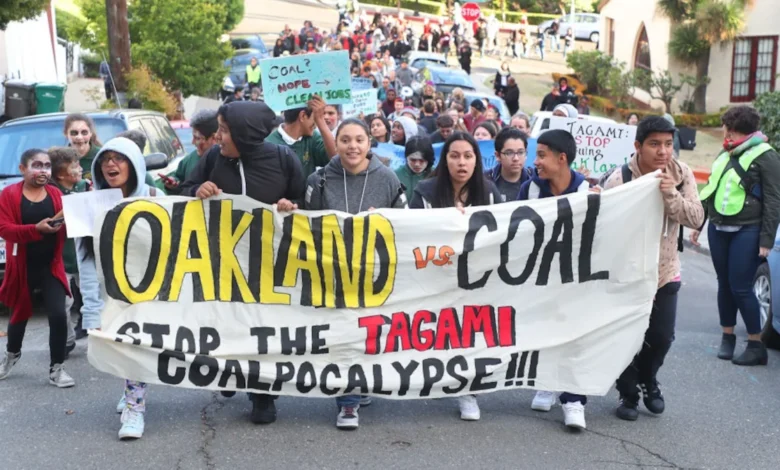
The discovery of the coal plan prompted the Oakland City Council to take swift legislative action. In 2016, following a series of emotional public hearings, the council passed an ordinance and a resolution banning the storage and handling of coal and coke within city limits. The city justified the move by citing the "substantial danger" coal dust posed to the health and safety of its citizens.
This legislative ban triggered the first major round of litigation. The developers sued the city in federal court, arguing that the 2013 development agreement included a "vested rights" clause. This clause effectively locked in the regulatory environment as it existed at the time of the signing, preventing the city from applying new rules to the project unless it could prove a "substantial danger" to public health. In 2018, U.S. District Judge Vince Chhabria ruled against the city, stating that the record Oakland had compiled to support its health claims was "riddled with inaccuracies" and "major evidentiary gaps." While the judge did not rule that coal was safe, he determined that the city had failed to meet the specific legal burden required to override the development agreement. This ruling was later upheld by the Ninth Circuit Court of Appeals in 2020.
Stymied in federal court, the City of Oakland pivoted to a contract-based strategy. In 2018, officials moved to terminate the developers’ lease, citing a failure to meet mandatory construction milestones. The developers countered with a lawsuit in state court, alleging that the city’s own obstruction and the ongoing litigation had made it impossible to meet those deadlines. The state courts once again sided with the developers, finding that the city’s actions had breached the implied covenant of good faith and fair dealing.
The financial stakes escalated further when Insight Terminal Solutions (ITS), the firm slated to operate the facility, filed for bankruptcy in Kentucky. During those proceedings, ITS sought more than $650 million in damages from Oakland, claiming the city’s opposition had destroyed the project’s value. Although a bankruptcy judge initially favored the firm, a federal district court vacated that ruling late last year, providing a temporary reprieve for the city’s strained treasury.
Federal Intervention and the "Energy Dominance" Strategy
The Department of Energy’s decision to allocate $75 million to the project marks a significant shift in the project’s viability. Energy Secretary Chris Wright defended the investment as a necessary step to overcome logistical bottlenecks on the West Coast. According to the Department, the lack of export capacity has historically limited the United States’ ability to supply global markets with energy resources, thereby ceding market share to international competitors.
"For too long, limited West Coast export capacity has constrained America’s ability to move coal and other energy resources to global markets," Wright stated. He characterized the funding as a strategic move to advance "American energy dominance" and ensure that domestic resources can reach burgeoning markets in the Indo-Pacific region.
This federal support arrives at a time when the domestic coal industry is facing an existential crisis. Data from the U.S. Energy Information Administration (EIA) shows that coal’s share of U.S. electricity generation has plummeted from nearly 50% in the mid-2000s to less than 17% today, surpassed by both natural gas and renewable energy sources like wind and solar. Despite this domestic decline, U.S. coal exports remained relatively resilient through 2023, as international demand—particularly for metallurgical coal used in steel production—persisted. The Oakland terminal is viewed by proponents as a critical link in maintaining this export pipeline.
Environmental and Public Health Concerns
The prospect of a coal terminal in West Oakland remains a source of deep concern for environmental groups and health advocates. Organizations such as the Sierra Club and San Francisco Baykeeper have warned that the transport of coal via rail cars and its storage at the waterfront would release "fugitive dust"—fine particulate matter (PM2.5) that can penetrate deep into the lungs and enter the bloodstream.
"This terminal project was drowning, and they’ve just been thrown the life preserver," said Ben Eichenberg, an attorney with San Francisco Baykeeper. He argued that the federal funding is a misguided attempt to prop up a "dying industry" at the expense of local air quality. Environmental advocates point out that West Oakland residents already face a life expectancy that is significantly lower than residents in the more affluent Oakland hills, a disparity they attribute largely to industrial pollution and diesel emissions from the port.
Furthermore, the project faces a daunting permitting process that federal funding cannot bypass. To begin operations, the terminal must secure air quality permits from the Bay Area Air Quality Management District (BAAQMD). This regional agency has historically been stringent regarding industrial emissions, and local advocates have already launched a campaign to ensure that any facility built at the site is held to the highest possible environmental standards.
Analysis of Broader Implications
The battle over the Oakland coal terminal reflects a broader tension in American governance: the conflict between federal energy priorities and municipal self-determination. The case raises fundamental questions about the limits of "vested rights" in development agreements and the extent to which a city can regulate commerce within its borders to protect public health.
From a geopolitical perspective, the project underscores the strategic importance of West Coast ports. As the U.S. seeks to strengthen economic ties with Asian allies, the ability to export energy resources becomes a tool of diplomacy and trade balance. However, this macro-level strategy often clashes with micro-level environmental justice concerns. The outcome of the Oakland terminal saga will likely serve as a precedent for how other coastal cities handle the transit of fossil fuels through their jurisdictions.
As the litigation continues and the permitting process begins, the $75 million federal grant ensures that the terminal project remains a live issue. For Phil Tagami and the developers, the funding provides the capital necessary to keep the project moving despite years of financial losses. For the City of Oakland, it represents a formidable new challenge in a legal marathon that shows no signs of concluding.
For now, the site of the former Oakland Army Base remains a quiet stretch of waterfront, but the air around it is thick with the weight of a decade of conflict. The coming years will determine whether this land becomes a bustling hub of international energy trade or remains a symbol of a community’s refusal to accept a legacy of coal. Environmental groups have vowed to scrutinize every permit and every federal dollar, ensuring that the final chapter of the Oakland coal terminal is still far from being written.