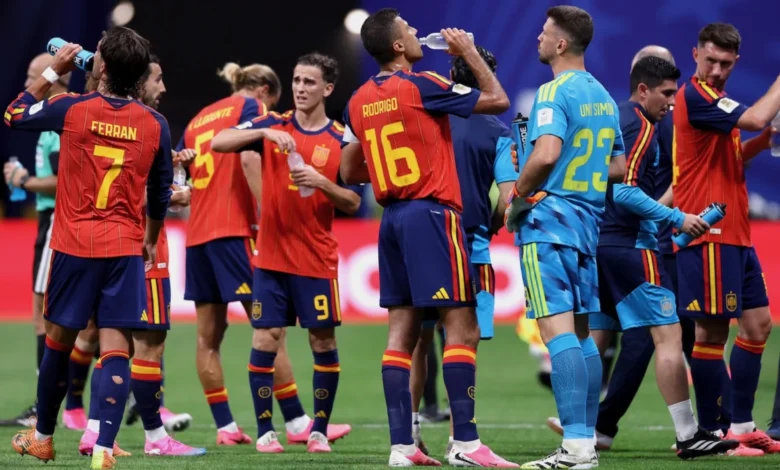
As the United States Men’s National Team prepares to take the pitch against Australia this afternoon, the global football community is focused on more than just tactical formations and star players. Millions of viewers tuning into the 2026 FIFA World Cup have been introduced to a structural shift in the game that has fundamentally altered the rhythm of the "beautiful game." For the first time in the tournament’s history, FIFA has mandated three-minute hydration breaks midway through each half of every match, regardless of the local climate or stadium conditions. While the governing body frames the decision as a critical evolution in player safety amid a warming planet, the move has ignited a firestorm of criticism from fans, broadcasters, and even the athletes themselves, who argue the breaks are a thinly veiled attempt to monetize the sport’s traditionally continuous clock.
The controversy, already dubbed "Water-gate" by British tabloids, represents a collision between two of the most pressing issues in modern sports: the physical toll of the climate crisis and the relentless pursuit of commercial revenue. The mandate represents a departure from previous protocols where "cooling breaks" were only implemented under extreme environmental stress. By making these pauses universal, FIFA has inadvertently created a new inventory of high-value advertising slots, leading to accusations that the organization is prioritizing its bottom line over the integrity of the sport.
A New Protocol for a Changing Climate
For decades, association football was defined by its relentless continuity. Aside from the 15-minute halftime interval, the clock ran for 45 minutes plus stoppage time, requiring players to maintain focus and physical output without scheduled respite. However, as global temperatures have climbed, the physical demands on elite athletes have become a matter of medical concern.
Before the 2026 tournament, the implementation of cooling breaks was governed by strict meteorological thresholds. FIFA’s previous policy relied on the Wet Bulb Globe Temperature (WBGT), a composite index that accounts for air temperature, humidity, wind speed, and solar radiation. Under the old rules, a cooling break was only considered if the WBGT exceeded 32 degrees Celsius (approximately 90 degrees Fahrenheit). This threshold was famously crossed during the 2014 World Cup in Brazil, specifically during a Round of 16 match between the Netherlands and Mexico in Fortaleza, marking the first time an official cooling break was utilized in World Cup history.
The 2026 mandate discards these environmental triggers entirely. The new rule requires a three-minute stoppage approximately 22 to 25 minutes into each half. This applies to all 104 matches of the expanded tournament, including those played in climate-controlled indoor venues like the Mercedes-Benz Stadium in Atlanta or the SoFi Stadium in Inglewood. FIFA’s official justification, released in a December policy announcement, states: "The use of hydration breaks is part of a focused attempt to ensure the best possible conditions for players, providing a uniform standard of care across all host cities and environmental conditions."
The Science of Heat Stress in Elite Athletics
The push for mandatory breaks did not emerge in a vacuum. It follows years of advocacy from FIFPRO, the global union for professional football players. Following the 2025 summer season, which saw record-breaking heatwaves across North America, FIFPRO released a scientific study highlighting the dangers of high-intensity performance in extreme heat. The organization argued that the traditional 90-minute format was becoming untenable in a world where "extreme heat events" are becoming more frequent and severe.
When an athlete performs at peak intensity, their core body temperature rises. In high humidity, the body’s primary cooling mechanism—the evaporation of sweat—is hindered. If the core temperature reaches critical levels, it can lead to heat exhaustion or the life-threatening condition of heatstroke. Proponents of the mandatory breaks argue that waiting for a specific temperature threshold to be met is reactive rather than proactive. By the time the WBGT reaches 32 degrees Celsius, players may already be experiencing the early stages of thermal strain.
However, the application of this rule to indoor, air-conditioned stadiums has weakened the "safety first" argument in the eyes of many critics. In these controlled environments, where temperatures are often maintained at a steady 70 degrees Fahrenheit, the physiological necessity of a mid-half stoppage is significantly reduced. This discrepancy has fueled the narrative that the breaks serve a secondary, more lucrative purpose.
The Commercial Windfall: Soccer’s New "Quarter" System
The most vocal criticism of the hydration breaks centers on their impact on broadcasting and advertising. Unlike American football or basketball, which are designed around frequent commercial interruptions, soccer has long been a sanctuary for brands seeking "clean" environments through jersey sponsorships and pitch-side LED boards. The introduction of two three-minute breaks per match has effectively divided the game into four quarters, creating four new "natural" windows for high-stakes television commercials.
The financial implications are staggering. According to data reported by The Wall Street Journal, the value of a 30-second advertisement during the 2026 World Cup has surged. For early group-stage matches, these spots are commanding roughly $200,000. For high-profile matches involving the U.S. National Team or major European powers, the price climbs to $750,000 or more. With nearly four and a half minutes of total ad time available during the breaks (allowing for 20 seconds of transition at the start and 30 seconds of lead-in at the end), FIFA and its broadcast partners have unlocked millions of dollars in previously non-existent inventory per match.
John Kosner, a veteran sports media executive and former ESPN vice president, noted that FIFA has "essentially divided the game into quarters and made enormously valuable breaks." This structural change has led to friction between broadcasters. While public service broadcasters like the BBC in the United Kingdom have opted to use the breaks for tactical analysis and replays, commercial giants like Fox in the United States have leaned heavily into ad rotations.
The risks of this commercialization were highlighted during the tournament’s opening match. The American broadcaster Fox cut to a commercial block during a hydration break 67 minutes into the game. However, the commercials ran longer than the players’ respite. When the broadcast returned to live action, the match had already resumed, leaving viewers frustrated and confused. While FIFA declined to sanction the network, the incident served as a cautionary tale for how commercial interests can disrupt the viewer experience.
Player and Fan Backlash: A "Momentum Killer"
While the breaks were ostensibly introduced for player welfare, the feedback from the pitch has been mixed. Virgil van Dijk, the veteran captain of the Netherlands squad, expressed a sentiment shared by many of his peers: "If it’s really hot, obviously it will be good to put them in. But I think you have to look at it in every game separately."
The primary sporting criticism is that the breaks act as a "momentum killer." In soccer, tactical dominance is often achieved through sustained pressure and the gradual fatigue of the opposition. A mandatory three-minute pause allows a struggling team to regroup, catch their breath, and receive tactical instructions from their coach—effectively acting as a "timeout" that does not exist in the laws of the game.
Fans have been even more pointed in their disapproval. During the match between England and Croatia, a chorus of boos erupted from the stands when the referee signaled for the mid-half break. The sentiment was echoed across social media platforms. On Reddit’s primary soccer community, users lamented the "Americanization" of the sport, with one viral comment stating, "FIFA ruined the beautiful game for the sake of a few more truck commercials."
Chronology of the Cooling Break Evolution
To understand how the sport reached this juncture, it is necessary to look at the timeline of FIFA’s approach to heat:
- Pre-2014: Cooling breaks were informal and left to the discretion of referees and team doctors, often resulting in inconsistent application.
- 2014 (Brazil): FIFA officially introduces "Cooling Breaks" for the World Cup. The first is used during the Netherlands vs. Mexico match on June 29, 2014, when the temperature hit 39°C (102°F).
- 2019 (France): During the Women’s World Cup, cooling breaks become more frequent as Europe experiences record-breaking heatwaves.
- 2022 (Qatar): Despite the tournament being moved to November/December to avoid the desert heat, stadium cooling technology and hydration protocols are prioritized, though mandatory breaks are not universal.
- December 2025: FIFA announces the "Hydration Break Mandate" for the 2026 World Cup, making 3-minute breaks mandatory for all matches regardless of temperature.
- June 2026: The tournament begins with widespread fan protests and broadcaster errors during the new mandated windows.
Analysis of Broader Implications
The "Water-gate" controversy is symptomatic of a larger tension within global sports. As climate change makes traditional outdoor summer schedules more hazardous, governing bodies must find ways to protect athletes. However, when those protections conveniently align with significant revenue increases, public trust is eroded.
The 2026 World Cup is the largest in history, featuring 48 teams and 104 matches across three nations (USA, Canada, and Mexico). The logistical complexity of managing such a tournament is immense, and FIFA’s argument for "uniformity" across 16 different host cities has some merit from a competitive balance standpoint. If a team in the relatively cool climate of Vancouver does not get a break while their potential next opponent in the sweltering heat of Monterrey does, questions of fairness could arise regarding recovery and fatigue.
Nonetheless, the blanket application of the rule suggests a shift toward a more "discretized" version of soccer, similar to the stop-and-start nature of American gridiron football. If these breaks become a permanent fixture of the sport, they may change how players are conditioned and how coaches manage their benches.
As the tournament progresses toward the knockout stages, the scrutiny on these hydration breaks will only intensify. FIFA faces the challenge of proving that these three-minute intervals are truly about the health of the players on the pitch rather than the health of the organization’s bank account. For now, as fans prepare for this afternoon’s clash between the U.S. and Australia, they are bracing not just for the action on the field, but for the mandatory pause that has become the most talked-about substitution in the history of the World Cup.