In a move that has sent shockwaves through the American environmental policy landscape, New York has officially become the first state in the nation to weaken a mandatory climate law previously passed by its own legislature. The decision, spearheaded by Governor Kathy Hochul and finalized through intense budget negotiations, marks a significant retreat from what was once considered the most ambitious climate agenda in the United States. By extending compliance deadlines and altering the fundamental ways in which greenhouse gas emissions are calculated, New York has signaled a pivot toward economic pragmatism over the rigid environmental timelines established just seven years ago.
The centerpiece of this policy shift is a ten-year extension for the state to meet its legally mandated emissions targets. Under the original 2019 Climate Leadership and Community Protection Act (CLCPA), New York was required to reduce its greenhouse gas emissions by 40 percent by 2030, using 1990 levels as a baseline. The new agreement, however, pushes this target back to 2040, while simultaneously introducing a new interim goal of a 60 percent reduction by that same year. Proponents of the change argue that the original timeline had become a mathematical impossibility without causing catastrophic economic disruption, while critics decry the move as a betrayal of the state’s role as a global climate leader.
The Evolution of the 2019 Climate Law
To understand the magnitude of this rollback, one must look at the origin of the CLCPA. When it was signed into law in 2019, the Act was hailed as a "Green New Deal" for the Empire State. It set a path toward a carbon-neutral economy by 2050 and mandated that 70 percent of the state’s electricity come from renewable sources by 2030. What set New York apart from other states were its "uniquely strict" accounting rules. Unlike the federal government or the United Nations, which typically measure the impact of greenhouse gases over a 100-year horizon, New York adopted a 20-year timeframe. This shorter window significantly amplified the perceived impact of methane—the primary component of natural gas—which is roughly 80 times more potent than carbon dioxide in the short term but dissipates much faster.
This accounting methodology effectively forced an immediate and aggressive transition away from natural gas. Because natural gas currently provides approximately 50 percent of New York’s electricity and serves as the primary heating fuel for the vast majority of the state’s residential and commercial buildings, the 20-year methane rule created a regulatory environment where fossil fuel infrastructure had to be dismantled at an unprecedented pace.
A Chronology of Missed Milestones and Economic Headwinds
The transition, however, stalled almost immediately. A combination of federal opposition, supply chain disruptions, and internal policy contradictions prevented the state from scaling up renewable energy at the required speed.
By 2021, the state faced its first major hurdle with the closure of the Indian Point Energy Center, a nuclear power plant that provided roughly 25 percent of New York City’s carbon-free electricity. While the closure was cheered by environmental groups concerned about safety, it created a massive energy vacuum that was largely filled by natural gas-fired power plants, causing the state’s emissions to tick upward rather than downward.
Between 2022 and 2024, the state’s offshore wind ambitions—central to meeting the 2030 goal—were battered by rising interest rates and inflation. Major developers like Ørsted and Equinor sought to renegotiate contracts, citing the soaring costs of materials. Simultaneously, political friction with the federal government under Donald Trump slowed the permitting process for several major projects. Although the state eventually secured progress on the Empire Wind and Sunrise Wind farms, these projects were insufficient to offset the continued reliance on gas.
By early 2025, the New York State Energy Research and Development Authority (NYSERDA) issued an internal memo warning that the state was nowhere near meeting its 2030 targets. The memo suggested that forcing compliance would require "pollution taxes" so high they would add thousands of dollars to the annual utility bills of average New Yorkers. This economic reality placed Governor Hochul, a moderate Democrat facing pressure from both the progressive left and a cost-conscious electorate, in a difficult political position.
Technical Changes: Redefining "Success" Through Accounting
The new deal does more than just delay the deadline; it fundamentally changes how New York defines a "ton" of pollution. The state is shifting its methane accounting from the 20-year framework back to the international standard of 100 years. This change aligns New York with the United Nations’ Paris Agreement standards but has the immediate effect of making natural gas appear less damaging to the climate on paper.
Furthermore, the state will no longer account for "upstream" emissions associated with the extraction of fossil fuels imported from other states. Previously, if a gas well in Pennsylvania leaked methane before the fuel reached New York, that leak was counted against New York’s carbon budget. By removing these out-of-state emissions from the ledger, New York will see its reported emissions drop by approximately 15 percent almost overnight, without actually changing the amount of gas being burned.
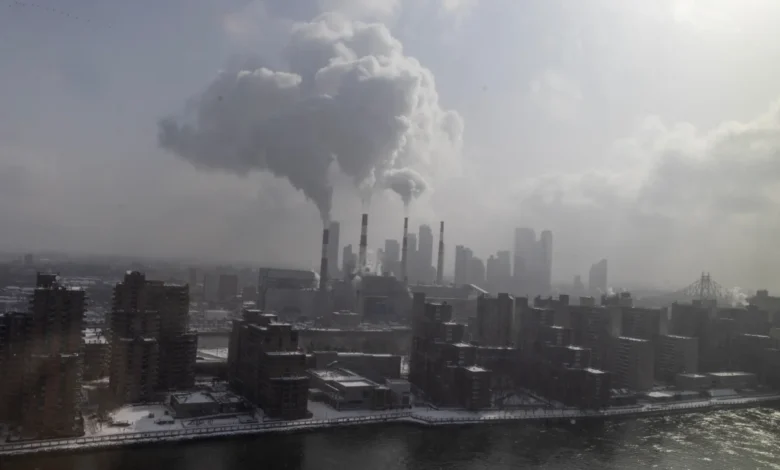
The livestock industry and landfill operators also stand to benefit. Under the 100-year framework, the warming impact attributed to these sectors will fall by nearly two-thirds. While climate scientists have long debated which timeframe is more accurate—arguing that the 20-year window is better for preventing immediate tipping points while the 100-year window is better for long-term stability—the political outcome is clear: the state can now claim progress toward its goals without the politically toxic "pollution taxes" that the previous math would have required.
The Stalled "Cap-and-Invest" System
Another casualty of the recent negotiations is the state’s "cap-and-invest" program. Originally slated to launch in 2025, the program—which would require major polluters to buy allowances for their emissions—has been delayed until 2028. Governor Hochul expressed concern that launching the system in the current economic climate would lead to a spike in gasoline prices and home heating costs.
The delay has particular implications for "disadvantaged communities." The original law mandated that 35 percent of the revenue generated from the cap-and-invest system be reinvested in neighborhoods disproportionately affected by pollution. State Assembly Member Marcella Mitaynes, who represents working-class neighborhoods in Brooklyn, noted that this funding was essential for addressing high asthma rates and building out green infrastructure in waterfront communities. The delay means these funds will not materialize for several more years, even as the state continues to rely on aging "peaker" gas plants in these very neighborhoods to prevent summer blackouts.
Infrastructure Realities: Buildings and the Grid
The struggle to decarbonize New York is perhaps most visible in its skyline. In New York City, Local Law 97 already requires large buildings to meet strict emissions limits by 2030. However, the cost of retrofitting a century-old apartment building with electric heat pumps can exceed $10 million. Many landlords have argued that the fines for non-compliance are actually cheaper than the cost of the upgrades.
The state’s independent grid operator (NYISO) has also issued stark warnings. Even with new transmission lines bringing hydropower from Canada and the introduction of offshore wind, the grid operator suggests that New York City could face a "reliability margin" of zero by 2031. This means that on the hottest days of the year, the city may not have enough electricity to meet demand without the very gas plants the state is trying to retire.
This reliability crisis was a primary driver behind Governor Hochul’s decision to approve water permits for new natural gas pipeline projects, such as the Williams Pipeline extension. While these moves are seen as necessary to "keep the lights on," they represent a stark departure from the "no new fossil fuel infrastructure" mantra that defined the 2019 legislative session.
Political Reactions and National Implications
The reaction to the rollback has been divided along predictable lines. Progressive legislators and environmental activists have accused the Governor of "dismantling" the state’s climate leadership. "This really came out of nowhere; it was sprung on us," said Assembly Member Mitaynes, reflecting the frustration of the legislature’s left wing.
Conversely, some economists and industry experts have welcomed the change as a necessary "reality check." Al McGartland, a former chief economist at the EPA, noted that the economy simply wasn’t cooperating with the original 2030 deadline. "It buys time to think this thing through carefully and do it right," he said.
From a national perspective, New York’s retreat may serve as a bellwether for other states with ambitious climate goals, such as California or Massachusetts. If a deep-blue state like New York finds its own mandates untenable due to consumer costs and grid reliability, other states may follow suit in "re-aligning" their targets.
Conclusion: A New Path Forward
As of 2026, New York’s climate strategy has entered a new phase characterized by incrementalism rather than radical transformation. The state continues to invest—committing $100 million to renewable power and increasing tax credits for building electrification—but the sense of urgency that defined the 2019 CLCPA has been replaced by a focus on "affordability and reliability."
The recent groundbreaking of a new gas pipeline in Brooklyn, attended by federal officials including Secretary of Energy Chris Wright and EPA head Lee Zeldin, serves as a potent symbol of this shift. While New York remains committed to a cleaner future in the long run, the immediate priority has shifted toward stabilizing energy costs for a population weary of inflation. For now, the "Empire State" has decided that the road to carbon neutrality will be a decade longer than originally promised.