The volatile standoff between the United States and Iran has intensified dramatically, pushing the Middle East closer to a full-scale regional conflict. Jordan’s strategic city of Aqaba saw its international airport and seaport evacuated on Sunday following a "specific and credible threat," as confirmed by the US embassy in Amman. This alarming development unfolded against a backdrop of renewed US airstrikes against Iranian targets and a series of retaliatory attacks by Tehran on US-allied nations, including missile and drone assaults on Kuwaiti military installations and vital infrastructure. The escalating hostilities mark the complete unraveling of a fragile ceasefire deal struck just a month prior, raising fears of widespread economic and humanitarian fallout across the crucial energy-rich region.
Intensified US Military Operations and Presidential Rhetoric
The latest wave of US military action, now in its eighth consecutive night, was launched to "swiftly punish" Iran’s Revolutionary Guard (IRGC) for a deadly attack in Jordan on Friday that resulted in the deaths of two American service members, left one missing, and hospitalized four others. US President Donald Trump, speaking to NewsNation, expressed his sorrow over the troops’ deaths, describing them as a "shame" and reaffirming his administration’s commitment to preventing Iran from acquiring nuclear weapons. "They did it because they don’t want to see Iran have a nuclear weapon," Trump stated, adding, "And it just shows you how bad (the Iranians) are." His dismissive response, "I couldn’t care less," when asked about Iran’s assertion that it would no longer honor the memorandum of understanding, underscores the deeply entrenched positions of both nations, with little room for de-escalation apparent.
The US Central Command (Centcom) confirmed that the airstrikes, initiated at 6 pm ET (10 pm GMT) on Saturday under President Trump’s direct orders, were also aimed at "further degrading" Iran’s capacity to disrupt commercial shipping through the Strait of Hormuz, a critical chokepoint for global oil supplies. Iranian state media, including Irna news agency and state-run broadcaster Irib, reported that targets included areas near Sirik, Hajiabad in the southern province of Hormozgan, and Qeshm Island, all strategically located along the vital energy shipping route. Explosions were reportedly heard in the port city of Bandar Abbas. Centcom later updated its social media channels, claiming successful strikes against "Iranian military coastal surveillance and air defense facilities, maritime capabilities, and missile and drone storage sites," signaling a sustained and comprehensive assault on Iran’s military infrastructure.

Iranian Retaliation and Strategic Countermeasures
Iran, for its part, has responded with a series of aggressive actions, underscoring its determination to resist US pressure and assert its regional influence. In the early hours of Sunday, the Kuwaiti army announced via a post on X that it was actively "dealing with hostile missile and drone attacks" following what it termed "Iranian aggression." The statement reassured residents that any audible explosions were likely the sound of air defense systems intercepting these incoming threats. The Iranian army had earlier claimed responsibility for targeting two US bases in Kuwait – an ammunition depot at Camp Buehring (formerly Camp Udairi) and radar and air surveillance systems at the Ali Al Salem air base – in direct retaliation for the overnight US strikes on Iranian soil. The immediate success or interception rate of these Iranian attacks remains unconfirmed.
Further exacerbating maritime tensions, Iran’s Revolutionary Guards reported an "accident" involving two ships attempting to transit the Strait of Hormuz via an "unsafe route." According to the Tasnim news agency, two other vessels purportedly abandoned this route. The IRGC explicitly stated that the four vessels had "ignored Iranian warnings and acted with US backing," issuing a stark warning: "Vessels that are influenced by the words of the Americans and enter unsafe routes will certainly face accidents." This statement directly challenges the US recommendation for mariners to use the southern route through Oman’s territorial waters to avoid Iranian-controlled areas, as Iran maintains a system of northern lanes close to its coast and insists on their exclusive use. The strategic implications of such maritime incidents in the Strait of Hormuz, through which roughly a fifth of the world’s oil supply passes, are immense, directly impacting global energy prices and the stability of international trade.
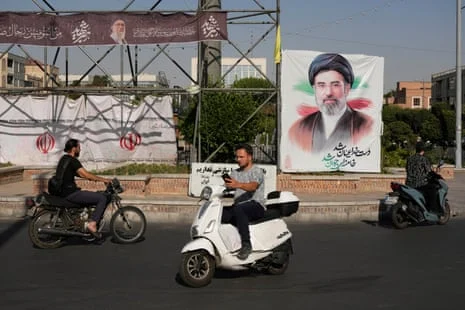
Iran’s Supreme Leader, Mojtaba Khamenei, issued a fierce condemnation of US actions, stating prior to the latest strikes that Washington would face repercussions for "seeking to escalate the conflict." In a statement widely circulated by official social media accounts and state media, Khamenei asserted that US actions had rendered President Trump’s signature "utterly worthless and devoid of credibility," ominously warning of "even heavier costs and further humiliation" for the United States. These declarations from Tehran underscore the deep ideological chasm and the zero-sum nature of the current confrontation.
Regional Instability and Humanitarian Concerns
The gravity of the situation was further highlighted by the US embassy in Jordan’s urgent advisory regarding Aqaba. The evacuation of the city’s international airport and seaport due to a "specific and credible threat" signals heightened alert levels in a country that shares a border with both Iraq and Saudi Arabia, making it a critical regional player. The embassy in Amman "strongly" advised all Americans to avoid travel to these key transportation hubs and military bases in Jordan, urging adherence to Jordanian authorities’ "security directives." This latest warning builds upon an earlier decision on March 2, when the US State Department ordered non-emergency US government employees and their family members to depart Jordan due to increasing "safety risks," indicating a sustained period of concern over regional stability. US citizens were also broadly advised to avoid protests, large gatherings, or areas with a significant police presence, and to generally maintain a "low profile."

The conflict’s reach extends beyond direct US-Iran confrontations, drawing in regional allies and proxies. Reports from Reuters indicated that Iran has instructed Yemen’s Houthi rebels to be prepared to close the Red Sea oil route should the US target Iranian power infrastructure. Such a move would have catastrophic global economic repercussions, disrupting shipping lanes and sending oil prices soaring. Furthermore, Iran has demonstrated its capability to inflict severe damage on US allied-Gulf countries. Tehran has already targeted power and desalination plants in Kuwait, threatening daily life in a nation that relies on desalinated water for approximately 90% of its drinking supply. This marks the second attack against a desalination plant in Kuwait in as many days, highlighting a clear strategy to exploit critical infrastructure vulnerabilities. While these attacks have been relatively limited in scope so far, the potential for wider, more devastating assaults remains a chilling possibility.
In Iraq, a drone strike early on Sunday hit a base near Irbil belonging to the Kurdistan Freedom Party, an Iranian Kurdish dissident group, wounding eight of its members, further illustrating the regional ripple effect of the escalating tensions. Meanwhile, sirens sounded across Bahrain, which hosts a significant US naval base and has been targeted by Iran in recent days. The Bahraini interior ministry urged residents to head to the nearest safe place of shelter, reflecting widespread alarm among Gulf allies.
Rising Casualties and A War of Attrition
The human cost of this renewed conflict is rapidly mounting. The two US troop deaths in Jordan on Friday represent the first direct casualties from Iranian fire since the initial phase of the "war" – an undeclared but increasingly overt military engagement – began. US Defense Secretary Pete Hegseth acknowledged the sacrifice on X, stating, "Their sacrifice only stiffens our resolve." These deaths bring the total number of US service members killed since the conflict escalated to 16, with over 430 having sustained injuries. On the Iranian side, the health ministry reported on Saturday that 50 people had been killed and more than 500 injured in US strikes on the country over the past three weeks, painting a grim picture of the widespread impact on civilian populations.
Dan Sabbagh, The Guardian’s defense and security editor, provided an insightful analysis last Friday, highlighting Iran’s enduring capacity to inflict damage despite the US’s superior military might. Sabbagh noted that while a frustrated US administration, with President Trump having publicly labeled Iran’s leaders as "scum" and "sick people" at this month’s NATO summit, is exploring options, a "substantial ground campaign" is not feasible given the US’s lack of preparedness and public appetite for such an undertaking. Discussions in the White House Situation Room reportedly included bombing deep-lying nuclear sites like Pickaxe Mountain or seizing strategic locations such as Kharg Island, through which 90% of Iran’s oil exports would normally flow. However, Sabbagh emphasized the challenges of holding such positions against inevitable Iranian missile and drone attacks. He also pointed to the ongoing depletion of both sides’ hard-to-replace air defense interceptors and expensive missiles, citing Center for Strategic and International Studies (CSIS) estimates of a 50% reduction in interceptors and a 25-33% reduction in missiles, suggesting a costly war of attrition.
Outlook: A Perilous Path Ahead
The current escalation represents a dangerous new chapter in the long-standing animosity between the US and Iran. The breakdown of the framework ceasefire agreement, which had offered a brief glimmer of hope for de-escalation, has now plunged the region back into an unpredictable and perilous state. With both sides demonstrating a willingness to engage in direct and proxy attacks, the potential for miscalculation leading to a broader, more devastating conflict is alarmingly high. The economic stability of the world, heavily reliant on Middle Eastern oil, and the humanitarian well-being of millions in the region hang precariously in the balance as leaders grapple with a rapidly deteriorating security landscape. The international community watches with bated breath, urging restraint, but facing an increasingly belligerent rhetoric and actions from Washington and Tehran alike. The path forward appears fraught with peril, with no clear diplomatic solution on the immediate horizon.