For decades, the Aral Sea has served as a harrowing monument to environmental mismanagement, a once-vast inland sea reduced to a toxic, salt-encrusted wasteland. Straddling the border between Kazakhstan and Uzbekistan, this body of water was once the world’s fourth-largest lake, covering an area of approximately 68,000 square kilometers. Today, however, its legacy is being rewritten not just as a regional ecological catastrophe, but as a significant and previously underestimated driver of global climate change. New research published in the journal Science reveals that the desiccation of the Aral Sea has transformed the basin from a vital carbon sink into a massive source of greenhouse gas emissions, pumping hundreds of millions of tons of carbon dioxide into the atmosphere.
The study, led by Rafael Marcé, a research scientist at the Centre for Advanced Studies in Blanes, Spain, underscores a "huge blind spot" in current climate modeling. While the world focuses on industrial emissions and deforestation, the "dry flux"—the release of carbon from drying lake beds—has remained largely unquantified. The findings suggest that the Aral Sea alone has released 748 million metric tons of carbon dioxide since its decline began in 1960, a figure that rivals the industrial output of entire nations and signals a potential climate tipping point.
The Limnology of a Carbon Sink
To understand why the drying of the Aral Sea is so catastrophic for the atmosphere, one must understand the natural function of large inland water bodies. Lakes and seas act as massive traps for organic matter. Over millennia, dead algae, plant material, and organic runoff from rivers settle at the bottom of these basins. In a healthy, water-filled lake, this material is buried under layers of sediment in an anaerobic (oxygen-free) environment. Under these conditions, decomposition is extremely slow, allowing the carbon to remain sequestered for centuries or even millennia.
"They accumulate carbon in the sediment," explained Marcé. "They are carbon sinks." However, when the water recedes and the lake bed is exposed to the air, the environment shifts from anaerobic to aerobic. Oxygen facilitates the rapid breakdown of this ancient organic matter by microbes, a process that converts stored carbon into carbon dioxide (CO2). What was once a permanent vault for carbon becomes a chimney, venting greenhouse gases directly into the sky.
A Chronology of Anthropogenic Collapse
The tragedy of the Aral Sea is not a natural occurrence but the result of deliberate geopolitical and economic decisions. The decline began in the 1960s under the Soviet Union’s "Great Plan for the Transformation of Nature." In an effort to turn the arid steppes of Central Asia into a global hub for "white gold"—cotton—Soviet engineers diverted the two main rivers that fed the Aral Sea: the Amu Darya and the Syr Darya.
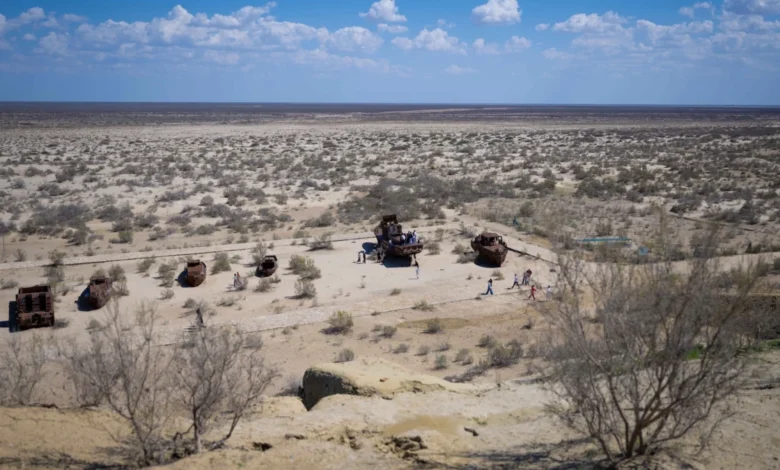
A massive network of irrigation canals, many of them unlined and inefficient, was constructed to siphon water away from the sea to quench the thirst of cotton fields in Uzbekistan and Turkmenistan. By the 1980s, the sea began to shrink at an accelerating rate. By 1987, the sea split into two separate bodies: the North Aral Sea in Kazakhstan and the much larger South Aral Sea in Uzbekistan. By the early 2000s, the South Aral Sea had further fractured and largely disappeared, leaving behind the "Aralkum Desert," a 60,000-square-kilometer expanse of salt and sand.
The timeline of this desiccation provided Marcé’s team with a unique opportunity. Because different parts of the sea dried up at different times, the researchers could treat the landscape as a chronological map. By taking sediment samples from areas that had been dry for decades and comparing them to areas that were submerged until recently, they were able to reconstruct the rate of carbon emission over a 62-year period.
Quantifying the "Dry Flux" Phenomenon
The results of the 2022 expedition to the Aral Sea were staggering. The 748 million metric tons of CO2 released between 1960 and 2022 represent more than three times the total annual emissions of Spain. The research highlighted a specific "pulse" of emissions following the retreat of the water. According to Marcé, roughly half of the total carbon stored in the top layers of sediment is released within the first 15 years of exposure.
"At the beginning it goes pretty fast, then it slowly decays," Marcé noted. This suggests that while the oldest dry sections of the Aral Sea are now releasing less CO2, the areas that have dried in the last decade are currently at their peak emission phase.
Furthermore, the study shed light on a secondary mechanism of emission: wind-blown sediment. Nearly 20% of the emissions from the Aral Sea basin are attributed to the "dust factor." As the lake bed dries, the fine sediment is picked up by powerful regional winds, creating massive "salt-dust storms" that can be seen from space. This dust not only carries toxic pesticides and fertilizers—remnants of decades of agricultural runoff—but also accelerates the oxidation of organic carbon by spreading it across the landscape.
Health and Ecological Repercussions
The implications of the Aral Sea’s disappearance extend far beyond climate statistics. The local populations in the Karakalpakstan region of Uzbekistan and southern Kazakhstan have faced a humanitarian crisis for decades. The salt-dust storms mentioned in the study have led to soaring rates of respiratory illnesses, esophageal cancer, and multidrug-resistant tuberculosis.
The loss of the sea also decimated a thriving fishing industry that once employed tens of thousands of people. Ports like Aralsk and Muynak now sit dozens of miles from the shoreline, with rusting "ship graveyards" serving as the only reminder of the region’s maritime past. The loss of the water’s moderating effect on the climate has also led to more extreme temperatures, with hotter summers and colder, harsher winters, further stressing the local agricultural systems that the original irrigation projects were meant to support.
A Global Blind Spot: From the Great Salt Lake to the Caspian
While the Aral Sea is the most extreme example, it is not an isolated incident. The "dry flux" phenomenon is occurring globally as climate change and human water consumption drain inland basins.
In the United States, the Great Salt Lake in Utah has reached record-low levels. A study led by Soren Brothers, a limnologist at the University of Toronto, found that the Great Salt Lake is currently releasing approximately 4 million tons of CO2 annually. Similarly, California’s Salton Sea is shrinking, creating both a public health hazard from toxic dust and a growing source of atmospheric carbon.
The Caspian Sea, the world’s largest inland body of water, is also under threat. Experts predict that the Caspian could shrink by an area larger than the entire Aral Sea by the end of the century due to rising temperatures and damming of the Volga River. Other vulnerable sites include Lake Chad in Africa and Lake Poopó in Bolivia.
"There is a whole bunch of CO2 coming out of the ground that no one was counting," said Soren Brothers. The inclusion of these figures in global carbon budgets could significantly alter how nations approach water management and land conservation.
The $18 Billion Opportunity for Restoration
Despite the grim findings, the research offers a glimmer of hope and a potential economic pathway for restoration. The study estimates that the Aral Sea still holds approximately 605 million metric tons of carbon that have yet to be released. If these remaining sediment layers are allowed to dry out completely, they will act as a "ticking climate bomb."
However, if the process can be halted or reversed, that carbon remains sequestered. Marcé and his colleagues argue that this carbon has a tangible economic value. At current market rates, the amount of CO2 that could be kept in the ground by protecting the Aral Sea’s remaining sediments is equivalent to roughly $18 billion in carbon credits.
This financial incentive could provide the necessary capital for massive infrastructure projects, such as modernizing the antiquated and leaky irrigation systems in the Amu Darya and Syr Darya basins. By reducing water waste in the cotton fields, more water could be allowed to reach the Aral Sea.
There is already a precedent for successful intervention. In 2005, the government of Kazakhstan, with support from the World Bank, completed the Kokaral Dam. This project was designed to save the North Aral Sea by preventing its water from flowing into the dry southern basin. Since its completion, water levels in the North Aral have risen, salinity has dropped, and the local fishing industry has seen a modest but significant revival. Expanding such efforts to the South Aral, however, would require unprecedented levels of international cooperation between Uzbekistan, Turkmenistan, and Kazakhstan.
Conclusion: A New Frontier in Climate Action
The revelation that the Aral Sea is a major source of carbon emissions changes the stakes of the conversation surrounding its restoration. It is no longer just a regional environmental tragedy or a local health crisis; it is a matter of global atmospheric stability.
"We need to start researching what is the path forward," said Soren Brothers. The study published in Science serves as a call to action for policymakers to recognize inland waters as critical components of the global carbon cycle. As the world seeks ways to meet the targets of the Paris Agreement, protecting the carbon "vaults" buried beneath the world’s lakes may prove to be one of the most effective, albeit challenging, tools available.
The Aral Sea’s transition from a lush sea to a dusty desert was a choice made in the 20th century. The research suggests that in the 21st century, we have the opportunity to make a different choice—one that prioritizes the stabilization of the climate and the restoration of one of Earth’s most significant geographic features. As Rafael Marcé put it, "It’s at least a chance."